
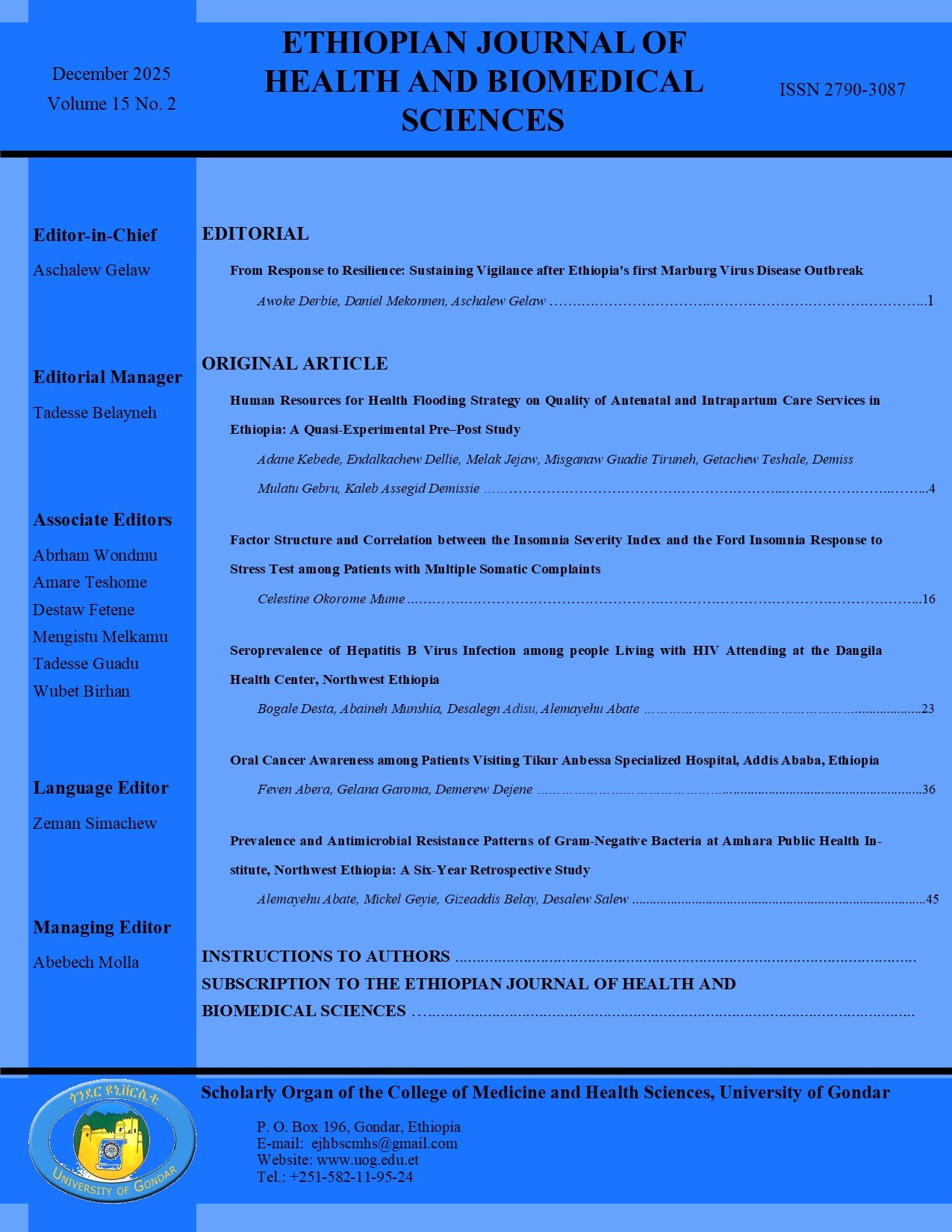
Oral Cancer Awareness among Patients Visiting Tikur Anbessa Specialized Hospital, Addis Ababa, Ethiopia
Background: Despite oral cancer being largely preventable and early detection significantly improving treatment outcomes, public awareness of its risk factors, early signs, and symptoms remains low, particularly in low-resource settings. In Ethiopia, late presentation is common, contributing to poor prognosis and increased morbidity. However, there is limited evidence regarding patients’ knowledge and awareness of oral cancer in Addis Ababa. This gap in information hinders the development of targeted educational and preventive strategies.
Objectives: To assess the awareness and knowledge of oral cancer among patients visiting Tikur Anbessa Specialized Hospital (TASH) to inform community education programs and early detection initiatives.
Methods: An institution-based cross-sectional study was conducted among 221 adult patients attending the Department of Dentistry and Oral and Maxillofacial Surgery at TASH from May to June 2023. Data were collected using a structured interviewer-administered questionnaire assessing awareness and knowledge of oral cancer, including risk factors, signs, symptoms, and preventive measures. Knowledge was measured using a composite score, and participants scoring ≥ the mean (2.11) were classified as having good knowledge. Associations between socio-demographic factors and knowledge were first explored using Chi-square tests, followed by multivariable logistic regression to identify independent predictors of good knowledge, with p < 0.05 considered statistically significant.
Results: Among participants (mean age 37.1 ± 13.8 years; 60.2% female), 75.1% (n = 166) had never heard of oral cancer. Among those aware (24.9%, n = 55), the primary sources of information were media (58.2%, n = 32), while only 18.2% (n = 10) received information from health professionals. Cigarette smoking (69.2%) and alcohol consumption (55.2%) were the most recognized risk factors, whereas family history (38.4%), poor oral hygiene (46.6%), and advanced age (36.2%) were less frequently identified. Awareness of signs and symptoms was low, with less than 40% identifying non-healing ulcers (38.9%) or abnormal swelling (33.0%). Overall, knowledge was poor among most participants. Urban residence (p = 0.0008) and higher education (p = 0.001) were significantly associated with better knowledge; gender was not.
Conclusion: Awareness and knowledge of oral cancer were low, highlighting the need for targeted community education, patient counseling by health professionals, and integration of oral cancer information into routine dental care to improve early detection and reduce disease burden.
Keywords
Authors
How to Cite
Download Citation
License
Copyright © 2025 The Author(s)

This work is licensed under a Creative Commons Attribution-NonCommercial 4.0 International License.
Similar Articles
- Akeem Olayinka Busari, Nimotallahi Temitope Omoteji, Idris Yahaya Mohammed, Investigation of hepatotoxic effect of cement-dust in occupationally exposed individuals at Malete, Kwara State, North Central Nigeria , Ethiopian Journal of Health and Biomedical Sciences: Vol. 14 No. 2 (2024)
- Ermias Diro, Situs Inversus Totalis with Aortopulmonary Shunt: A Case Report in an Ethiopian , Ethiopian Journal of Health and Biomedical Sciences: Vol. 2 No. 1 (2009)
- Yitayih Wondimeneh, Rubella Associated Maternal and Child Health Problems in the Vaccine Era , Ethiopian Journal of Health and Biomedical Sciences: Vol. 10 No. 1 (2020)
- Teklu Bekele, Yonas Yilma, Abebe Bekele, Riedel’s Thyroiditis in an Ethiopian Patient , Ethiopian Journal of Health and Biomedical Sciences: Vol. 1 No. 1 (2008)
- Biniam Kefiyalew, Tezera Tadele, Zeleke Mekonnen, Binyam Tilahun, Bethelhem Anteneh, Alemayehu Teklu, Community engagement platforms for Compassionate Respectful and Caring health service: challenges and opportunities, in Sululta district, Ethiopia , Ethiopian Journal of Health and Biomedical Sciences: Vol. 12 No. 1 (2022)
- Jumoke Ilo, Abiodun Ifebajo, Abimbola Yusuf, Oluseye Onabanjo, Assesment of the Impact of Energy Drink Consumption on Nutritional Status of Undergraduate Students in Ogun State, Nigeria , Ethiopian Journal of Health and Biomedical Sciences: Vol. 15 No. 1 (2025)
- Awoke Derbie, Daniel Mekonnen, Aschalew Gelaw, From Response to Resilience: Sustaining Vigilance after Ethiopia's first Marburg Virus Disease Outbreak , Ethiopian Journal of Health and Biomedical Sciences: Vol. 15 No. 2 (2025)
- Dagnew Engdaw, Hameed Sulaiman, Seyoum Leta, Determining the Generation Rate and Composition of Solid Health Care Waste at Gondar University Hospital , Ethiopian Journal of Health and Biomedical Sciences: Vol. 2 No. 1 (2009)
- Yigzaw Kebede, Gashaw Andarge, Tesfahun Melesse, Temesgen Azmeraw, Takele Tadesse, Yiforkir Tefera, Abebaw Gebeyehu, Tadesse Awoke, Kassahun Alemu, Sisay Yifru, Afework Kassu, Tefera Abula, Mengesha Admassu, Shitaye Alemu, Solomon Meseret, Digsu Negesse, Getu Degu, Solomon Mekonnen, Berihun Megabiaw, Wondwosen Zemene, Assefa Getachew, Belaynew Wassie, Solomon Amsalu, Mamo Wubshet, Mezgebu Yitayal, Fasil Tessema, Yihunie Lakew, Tariku Dejene, Ejigu Gebeye, Melkamu Birku, Yosef Fekadu, Population Dynamics in Dabat Health and Demographic Surveillance System Sites, Dabat District, Northwest Ethiopia: A Four-year Surveillance Report (2009 To 2012) , Ethiopian Journal of Health and Biomedical Sciences: Vol. 7 No. 1 (2015)
- Adane Nigussie, Lidia Gebiru, Dawit Muluneh, Binyam Tilahun, The role of Performance appraisal system on Compassionate, Respectful, and Caring health care delivery in Northwest Ethiopia: an implementation study , Ethiopian Journal of Health and Biomedical Sciences: Vol. 12 No. 1 (2022)
You may also start an advanced similarity search for this article.