
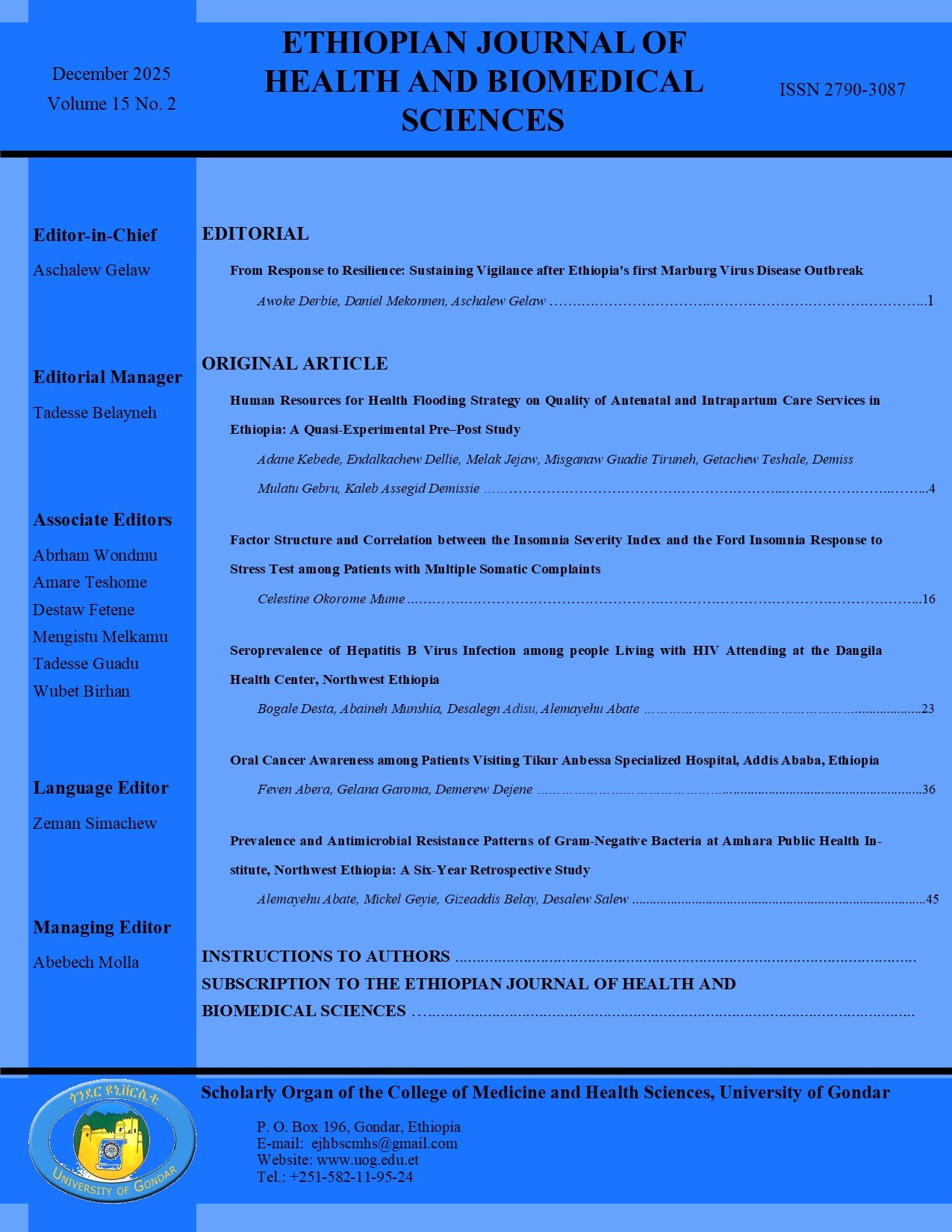
Factor Structure Analysis and Total Score Correlation of the Insomnia Severity Index and the Ford Insomnia Response to Stress Test in Patients with Multiple Somatic Complaints
Background: Insomnia and sleep reactivity are common among patients presenting with multiple somatic complaints. The Insomnia Severity Index (ISI) and the Ford Insomnia Response to Stress Test (FIRST) are widely used instruments to assess insomnia severity and sleep reactivity, respectively. However, their factor structures and interrelationships have not been examined in this population.
Objective: To determine the factor structure and internal consistency of the ISI and FIRST and assess the correlation between their total scores among patients with multiple somatic complaints.
Materials and Methods: A cross-sectional study was conducted among 111 adult psychiatric outpatients presenting with multiple somatic complaints at Obafemi Awolowo University Teaching Hospitals Complex, Nigeria. Sociodemographic data were collected, and participants completed the ISI and FIRST questionnaires. Exploratory Factor analysis using maximum likelihood extraction with varimax rotation was applied to the ISI, while principal component analysis was used for the FIRST. Internal consistency was assessed using Cronbach’s alpha. Correlation and simple linear regression analyses were performed to evaluate associations between the instruments.
Results: Data from 110 participants were analyzed (mean age 39.4 ± 8.7 years; 58.2% female). The ISI demonstrated a two-factor structure explaining 47.22% of the variance, with an overall Cronbach’s alpha of 0.67. The FIRST demonstrated a single-factor structure explaining 56.40% of the variance, with excellent reliability (Cronbach’s alpha = 0.90). A significant positive correlation was observed between ISI and FIRST scores (r = 0.40, p < 0.01). Linear regression analysis showed that sleep reactivity accounted for 15% of the variance in insomnia severity (Adjusted R² = 0.150, p < 0.01).
Conclusion: The ISI and FIRST demonstrated acceptable construct validity and reliability in this population. Sleep reactivity was significantly associated with insomnia severity, supporting the clinical utility of FIRST in identifying individuals at risk for insomnia.
Keywords
Authors
How to Cite
Download Citation
License
Copyright © 2025 The Author(s)

This work is licensed under a Creative Commons Attribution-NonCommercial 4.0 International License.
Similar Articles
- Getachew Ferede, Moges Tiruneh, Ebba Abate, Yitayih Wondimeneh, Endalamaw Gadisa, Rawleigh Howe, Abraham Aseffa, Belay Tessema, Evaluation of the Performance of the SD Bioline Dengue Rapid Test For the Detection of Anti-Dengue IgM Antibody in Northwest Ethiopia , Ethiopian Journal of Health and Biomedical Sciences: Vol. 11 No. 1 (2021)
- Baye Gelaw, Bacteriophage Based Assay to Detect Mycobacteria in the Sputum of Tuberculosis Patients , Ethiopian Journal of Health and Biomedical Sciences: Vol. 6 No. 1 (2014)
- Olufemi A. Ige, Kolawole A. Ige, Israel K. Kolawole, Comparative Effects of Two Epidural Analgesia Maintenance Techniques on Labor Outcomes in Primiparous Women , Ethiopian Journal of Health and Biomedical Sciences: Vol. 16 No. 1 (2026)
- Alemayehu Bishaw, Comparison of Process-Based and Traditional Approaches in Developing Students’ Knowledge and Attitude towards the Prevention of HIV/AIDS in Gimijabet Elementary School , Ethiopian Journal of Health and Biomedical Sciences: Vol. 3 No. I (2010)
- Akeem Olayinka Busari, Nimotallahi Temitope Omoteji, Idris Yahaya Mohammed, Investigation of hepatotoxic effect of cement-dust in occupationally exposed individuals at Malete, Kwara State, North Central Nigeria , Ethiopian Journal of Health and Biomedical Sciences: Vol. 14 No. 2 (2024)
- Judith P. Cheong-Leen, Abdulmenan Mohammednur, Abdulrahman Tune, Ashebir Nigussie, Afework Amiha, Alemu Girma, Gashaw Messele Messele, Benjamin d.Z. Silverman, Post-Operative Pain and Analgesia at the University of Gondar Hospital , Ethiopian Journal of Health and Biomedical Sciences: Vol. 5 No. 1 (2012)
- Yonas Yilma, Teklu Bekele, Madelung’s Disease: Report of a Case , Ethiopian Journal of Health and Biomedical Sciences: Vol. 2 No. 1 (2009)
- Getachew Ferede, Moges Tiruneh, Ebba Abate, Yitayih Wondimeneh, Belay Tessema, Uwe G Liebert, Distribution of Dengue Virus Serotype Based on Neutralization Assay in Northwest Ethiopia , Ethiopian Journal of Health and Biomedical Sciences: Vol. 13 No. 1 (2023)
- Amare Minyihun, Masrie Genet, Binyam Tilahun, How to strengthen the Monitoring and Evaluation System to improve Compassionate, Respectful, and Caring services in Ethiopia: An implementation study , Ethiopian Journal of Health and Biomedical Sciences: Vol. 12 No. 1 (2022)
- Molla Gedefaw, Kassa Darge, Effects of Ivermectin Treatment of Sowda (Hyperreactive Onchodermatitis) in Ghanian Patients , Ethiopian Journal of Health and Biomedical Sciences: Vol. 1 No. 1 (2008)
You may also start an advanced similarity search for this article.