
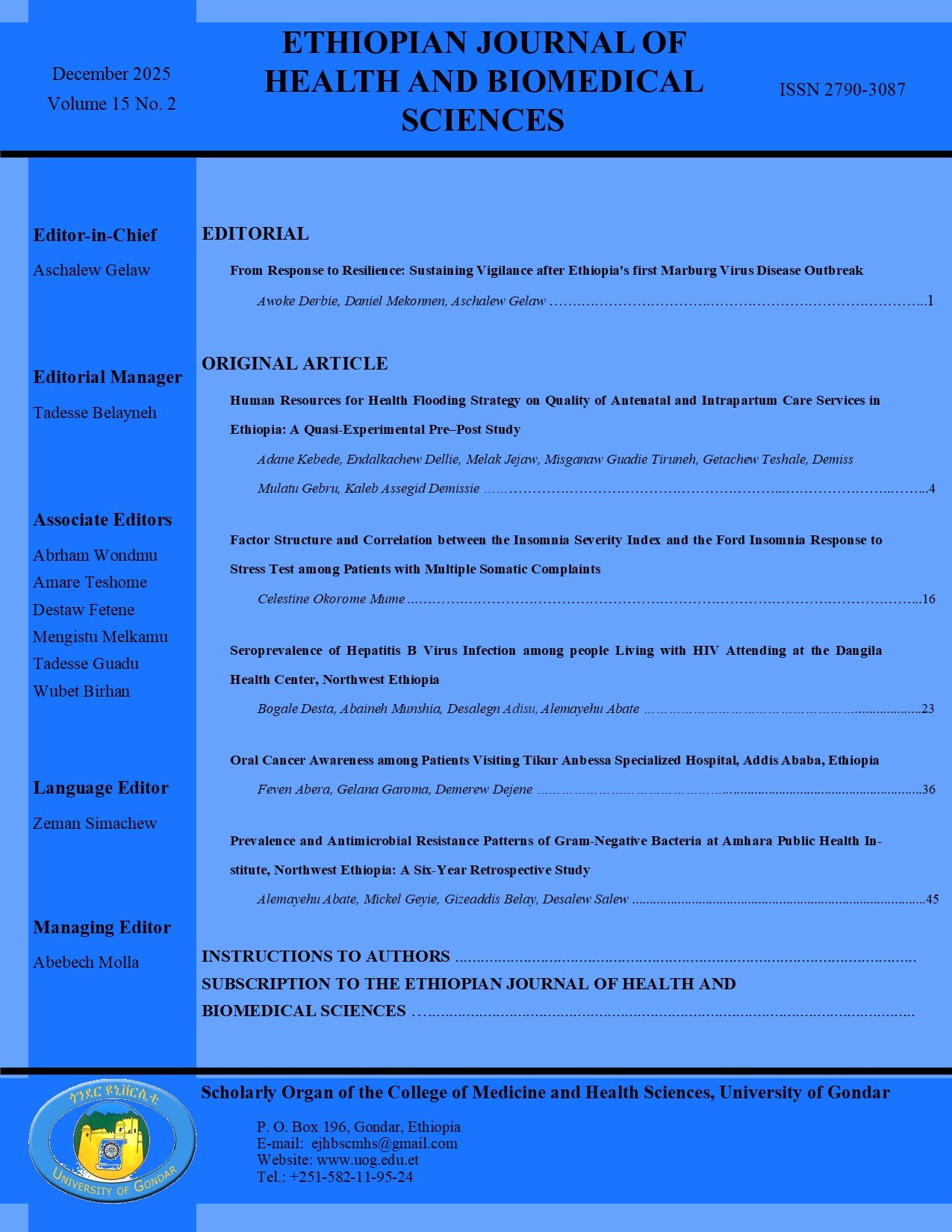
Impact of Human Resources for Health flooding Strategy on Quality of ANC and Intrapartum care service in Ethiopia: A quasi-experimental pre-post study
Background: Ethiopia has implemented a Human Resources for Health (HRH) flooding strategy since 2011 to rapidly expand the availability of health professionals nationwide. Although this approach is expected to strengthen the healthcare workforce, its effects on healthcare quality and service delivery outcomes have not been comprehensively evaluated.
Objective: This study assessed the association between the HRH flooding strategy and maternal healthcare quality, with a focus on antenatal and intrapartum care, to inform strategies for optimizing the effectiveness of workforce investment.
Methods: A quasi-experimental pre-post design with propensity score matching was employed to evaluate changes in care quality following implementation of the HRH flooding strategy. Data were pooled from two rounds of the Ethiopian Demographic and Health Survey (EDHS), using the 2011 EDHS as the pre-intervention control group and the 2016 EDHS as the post-intervention group. The primary outcomes were the quality of antenatal care (ANC) and intrapartum care provided.
Results: The quality of ANC was 27.1% (95% CI: 25.7–28.6) in the treatment group compared to 8.5% (95% CI: 7.5–9.6) in the control group. Similarly, the quality of intrapartum care was 44.0% (95% CI: 42.4–45.6) and 20.8% (95% CI: 19.3–22.5) in the treatment group and control group, respectively. The average treatment effect of the HRH flooding strategy was associated with a 13.5 percentage-point improvement in the quality of ANC and a 23.3 percentage-point improvement in the quality of intrapartum care. Using a 0.01 caliper, radius matching achieved a strong balance between treatment and control groups.
Conclusion: Implementing the HRH flooding strategy is positively associated with improvements in the quality of ANC and intrapartum care services in Ethiopia. However, these findings should be interpreted with caution, as unmeasured confounding factors, including concurrent health system programs, may have contributed to the observed effect.
Keywords
Authors
How to Cite
Download Citation
License
Copyright © 2025 The Author(s)

This work is licensed under a Creative Commons Attribution-NonCommercial 4.0 International License.
Similar Articles
- Adane Derso, Aberham Abere, Yalewayker Tegne, Gezahegn Bewket, Amare Kiflie, Prevalence and risk factors of Helicobacter pylori infection among Pregnant Women in Northwest Ethiopia , Ethiopian Journal of Health and Biomedical Sciences: Vol. 12 No. 2 (2022)
- Meheretie Kokeb, Teklu Bekele Legesse, Bacillary Angiomatosis in an Ethiopian Child: A Case Report , Ethiopian Journal of Health and Biomedical Sciences: Vol. 2 No. 2 (2010)
- Baye Gelaw, Bacteriophage Based Assay to Detect Mycobacteria in the Sputum of Tuberculosis Patients , Ethiopian Journal of Health and Biomedical Sciences: Vol. 6 No. 1 (2014)
- Asratie Guangul , Bahiru Tenaw , Sileshi Ayehualem, Abebe Muche, Radiographic Assessment of Cardiothoracic Ratio in Apparently Healthy Adults in Bahir Dar, Northwest Ethiopia , Ethiopian Journal of Health and Biomedical Sciences: Vol. 12 No. 2 (2022)
You may also start an advanced similarity search for this article.
Most read articles by the same author(s)
- Adane Kebede, Measho Gebreslassie, Mezgebu Yitayal, Willingness to Enroll For Community-Based Health Insurance and Associated Factors among Household Heads in the Rural Community of Fogera District, Northwest Ethiopia , Ethiopian Journal of Health and Biomedical Sciences: Vol. 10 No. 1 (2020)