
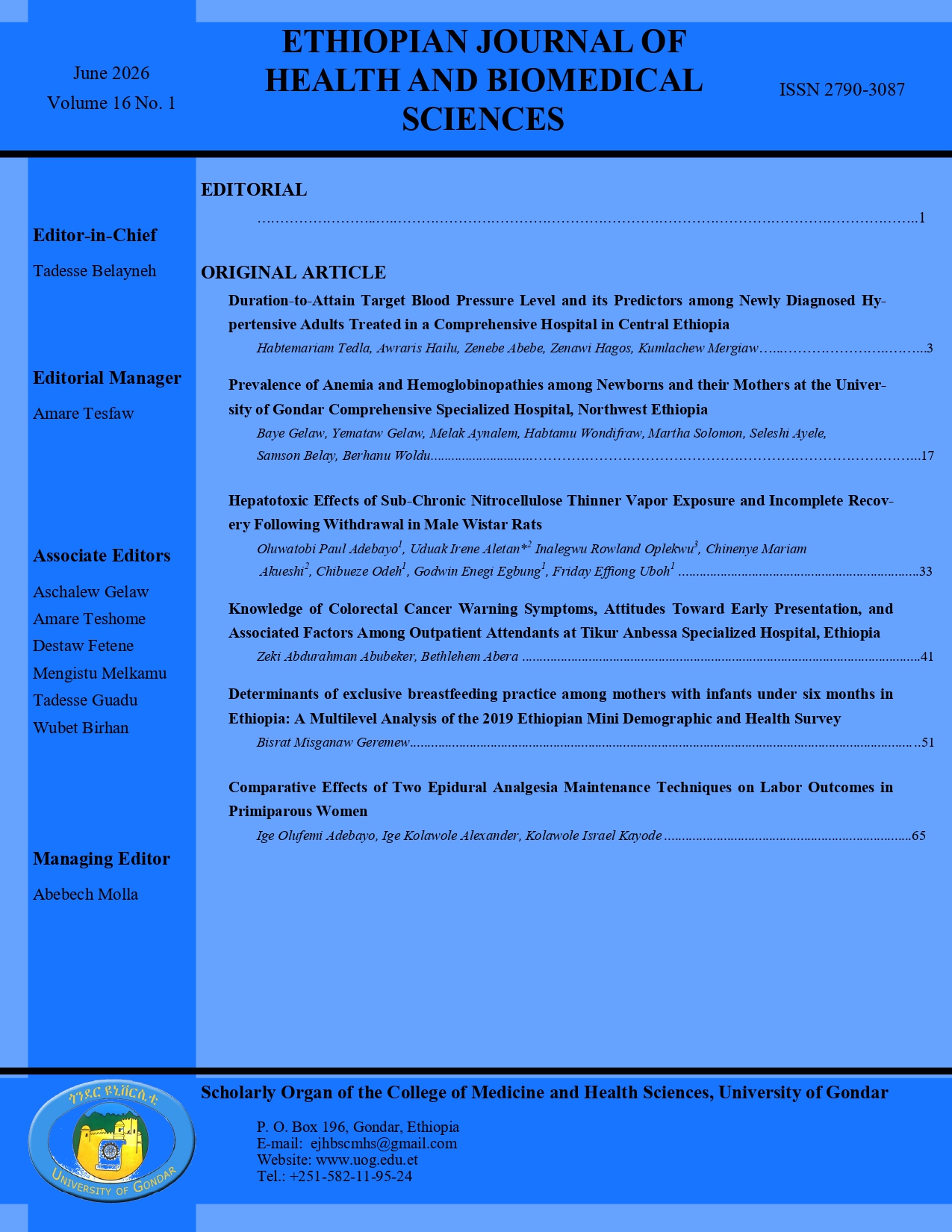
Duration-to-Attain Target Blood Pressure Level and Its Predictors among Newly Diagnosed Hypertensive Adults Treated in a Comprehensive Hospital in Central Ethiopia
Background: Timely blood pressure (BP) control is essential for preventing hypertension-related complications. However, longitudinal evidence on the time required to achieve target BP and its predictors among newly diagnosed hypertensive patients remains limited in Ethiopia. This study assessed the time to BP control and its predictors among newly diagnosed hypertensive adults receiving care at a comprehensive hospital in Central Ethiopia.
Methods: A five-year retrospective cohort study was conducted among 522 newly diagnosed hypertensive adults enrolled between 2021 and 2025. The primary outcome was time to BP control, defined as achieving a BP <140/90 mmHg at two consecutive follow-up visits. Participants were selected using systematic random sampling, and data were extracted from medical records by trained personnel. Missing data were handled using hot-deck imputation. Kaplan–Meier survival analysis and the log-rank test were used to compare time to BP control across groups. Variables meeting the proportional hazards assumption and a bivariate screening criterion of P < 0.25 were included in a multivariable Cox proportional hazards model to identify independent predictors. Statistical significance was declared at P < 0.05.
Results: Of the 522 patients included, 377 (72.2%) achieved BP control during 191,056 person-days of follow-up, corresponding to an incidence rate of 1.97 BP control events per 1,000 person-days (72 events per 100 person-years). The overall median time to BP control was 375 days (12.5 months; 95% CI: 338–410). Males required a longer median time than females (400 vs. 352 days). Urban residence (adjusted hazard ratio [AHR] = 1.36; 95% CI: 1.05–1.74), initiation with dual antihypertensive therapy (AHR = 1.52; 95% CI: 1.12–2.06), and normal total cholesterol levels (AHR = 2.09; 95% CI: 1.48–2.96) were independently associated with a shorter time to BP control. In contrast, the presence of comorbidities (AHR = 0.23; 95% CI: 0.16–0.33) and advanced baseline blood pressure severity independently prolonged the time required to achieve target levels. Compared to those who had baseline SBP of 140-159 mmHg, patients who had systolic blood pressure (SBP) of 160-179 mmHg and ≥180 mmHg showed significantly reduced rates of achieving timely blood pressure control (AHR = 0.61; 95% CI: 0.47–0.80 and AHR = 0.36; 95% CI: 0.24–0.54, respectively). Similarly, patients who had diastolic blood pressure (DBP) of 99-109 mmHg and ≥110 mmHg had strongly delayed treatment success (AHR = 0.53; 95% CI: 0.41–0.71 and AHR = 0.36; 95% CI: 0.23–0.56, respectively) compared with patients with DBP of 90-99 mmHg.
Conclusion: Newly diagnosed hypertensive patients experienced substantial delays in achieving target BP, with a median time to control exceeding one year. Early initiation of dual antihypertensive therapy and urban residence were associated with faster BP control, whereas higher baseline systolic and/or diastolic BP levels and comorbidities significantly prolonged the time to achieving target BP. Targeted management strategies for high-risk patients may help accelerate BP control and improve clinical outcomes.
Keywords
Authors
How to Cite
Download Citation
License
Copyright © 2026 The Author(s)

This work is licensed under a Creative Commons Attribution-NonCommercial-NoDerivatives 4.0 International License.
Similar Articles
- Destaw Fetene Teshome, Shitaye Alemu Balcha, Tadesse Awoke Ayele, Asmamaw Atnafu, Kassahun Alemu Gelaye, The role of health extension workers in combating hypertension in Ethiopia , Ethiopian Journal of Health and Biomedical Sciences: Vol. 14 No. 1 (2024)
- Alebachew Abebe, Kumela Ayansa, Kasahun Takele, Modeling Determinants of Time to Death of Stroke Patients at Harar Regional State, Ethiopia: Application of Shared Frailty Models , Ethiopian Journal of Health and Biomedical Sciences: Vol. 15 No. 1 (2025)
- Aschalew Gelaw, Recent Updates on the Epidemiology and Immunizations of Measles Virus in Ethiopia , Ethiopian Journal of Health and Biomedical Sciences: Vol. 13 No. 2 (2023)
- Moges Tadesse, Takele Tadesse, Hardeep Rai Sharma, Mengsha Admassu, Prevalence of Needle-Stick Injuries and Associated Factors among Health Care Workers at Hawassa Town, South Ethiopia , Ethiopian Journal of Health and Biomedical Sciences: Vol. 2 No. 2 (2010)
- Melsew Yihunie Belay, Getahun Mengistu, Adugnaw Zeleke Alem, Tilahun Yemanu Birhan, Time to Recovery from Undernutrition and Its Predictors among Patients with Multidrug-Resistant Tuberculosis in Addis Ababa, Ethiopia , Ethiopian Journal of Health and Biomedical Sciences: Vol. 13 No. 2 (2023)
- Bahiru Tenaw, Abebe Muche, Engidaw Fentahun , Abyot Endale , An Evaluation of Acute and Sub-Acute Toxicity of Methanolic Root Extract Of Myricasalicifolia A. Rich (Myricaceae) On the Histopathology of the Liver, the Kidney and Some Blood Parameters in Swiss Albino Mice , Ethiopian Journal of Health and Biomedical Sciences: Vol. 9 No. 1 (2019)
- Segen Tekle, Feleke Moges, Zemene Tigabu, Alem Getaneh, Bacterial Profile and Their Antibiotic Resistance Patterns from Blood Culture and Associated Risk Factors in Intensive Care Unit at the University Of Gondar Comprehensive Specialized Hospital, Northwest Ethiopia , Ethiopian Journal of Health and Biomedical Sciences: Vol. 10 No. 1 (2020)
- Gebru Gebremeskel Gebrerufael, Bsrat Tesfay Hagos, Predictors of neonatal mortality in Tigray Regional State, Northern Ethiopia: a comparison of parametric survival models’ approaches , Ethiopian Journal of Health and Biomedical Sciences: Vol. 14 No. 1 (2024)
- Getachew Ferede, Dengue Fever as an Emerging Health Concern in Ethiopia , Ethiopian Journal of Health and Biomedical Sciences: Vol. 9 No. 1 (2019)
- Baye Gelaw, Shimelis Assefa, Takele Teklu, Simon G/tsadik, Wubet Berhane, Meseret Alem, Yetayal Sheferaw, Audit on the Laboratory Diagnosis of Malaria Parasites at the University of Gondar Hospital Laboratory, Northwest Ethiopia , Ethiopian Journal of Health and Biomedical Sciences: Vol. 3 No. I (2010)
You may also start an advanced similarity search for this article.