
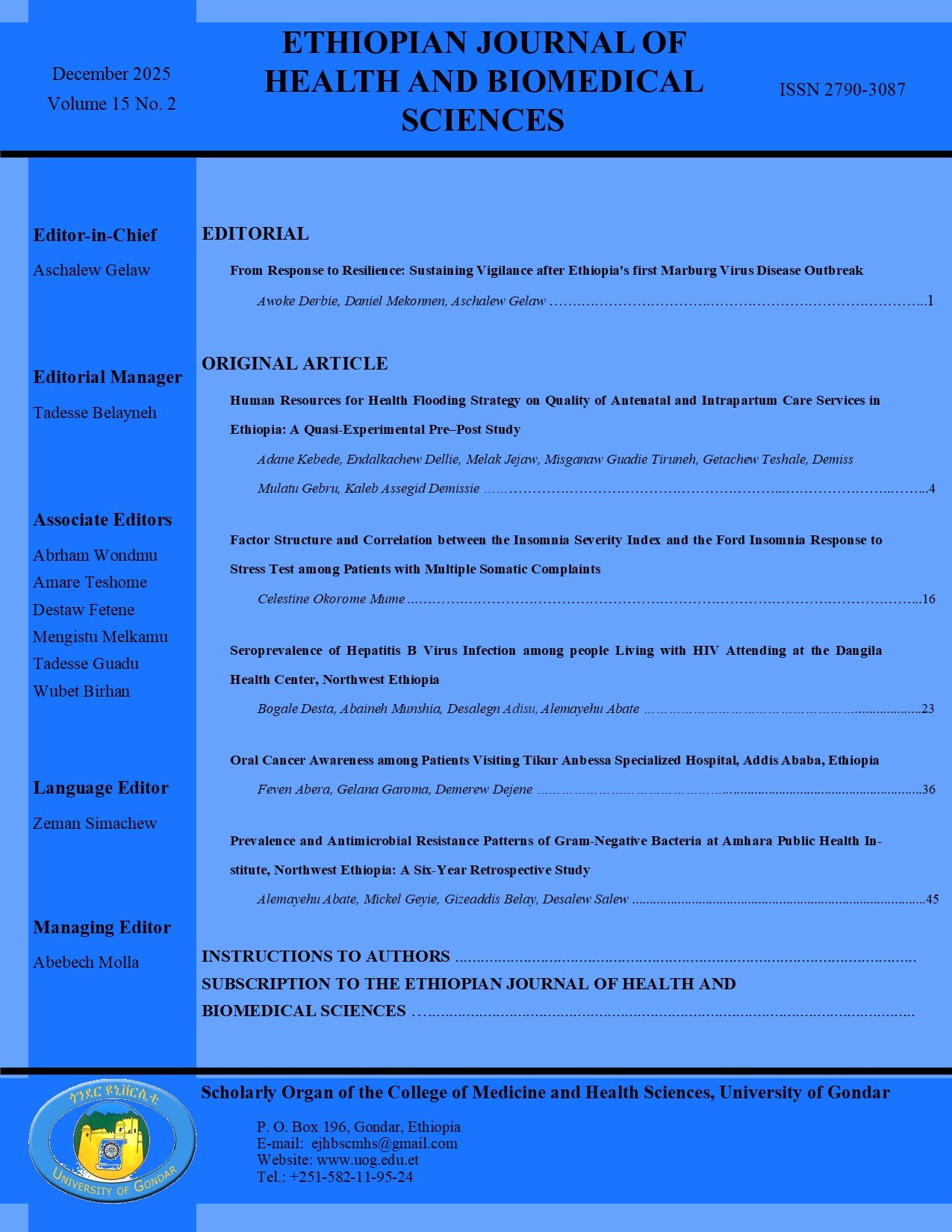
Oral Cancer Awareness among Patients Visiting Tikur Anbessa Specialized Hospital, Addis Ababa, Ethiopia
Background: Despite oral cancer being largely preventable and early detection significantly improving treatment outcomes, public awareness of its risk factors, early signs, and symptoms remains low, particularly in low-resource settings. In Ethiopia, late presentation is common, contributing to poor prognosis and increased morbidity. However, there is limited evidence regarding patients’ knowledge and awareness of oral cancer in Addis Ababa. This gap in information hinders the development of targeted educational and preventive strategies.
Objectives: To assess the awareness and knowledge of oral cancer among patients visiting Tikur Anbessa Specialized Hospital (TASH) to inform community education programs and early detection initiatives.
Methods: An institution-based cross-sectional study was conducted among 221 adult patients attending the Department of Dentistry and Oral and Maxillofacial Surgery at TASH from May to June 2023. Data were collected using a structured interviewer-administered questionnaire assessing awareness and knowledge of oral cancer, including risk factors, signs, symptoms, and preventive measures. Knowledge was measured using a composite score, and participants scoring ≥ the mean (2.11) were classified as having good knowledge. Associations between socio-demographic factors and knowledge were first explored using Chi-square tests, followed by multivariable logistic regression to identify independent predictors of good knowledge, with p < 0.05 considered statistically significant.
Results: Among participants (mean age 37.1 ± 13.8 years; 60.2% female), 75.1% (n = 166) had never heard of oral cancer. Among those aware (24.9%, n = 55), the primary sources of information were media (58.2%, n = 32), while only 18.2% (n = 10) received information from health professionals. Cigarette smoking (69.2%) and alcohol consumption (55.2%) were the most recognized risk factors, whereas family history (38.4%), poor oral hygiene (46.6%), and advanced age (36.2%) were less frequently identified. Awareness of signs and symptoms was low, with less than 40% identifying non-healing ulcers (38.9%) or abnormal swelling (33.0%). Overall, knowledge was poor among most participants. Urban residence (p = 0.0008) and higher education (p = 0.001) were significantly associated with better knowledge; gender was not.
Conclusion: Awareness and knowledge of oral cancer were low, highlighting the need for targeted community education, patient counseling by health professionals, and integration of oral cancer information into routine dental care to improve early detection and reduce disease burden.
Keywords
Authors
How to Cite
Download Citation
License
Copyright © 2025 The Author(s)

This work is licensed under a Creative Commons Attribution-NonCommercial 4.0 International License.
Similar Articles
- Betelhem Abera, Zeki Abubeker, Knowledge of Colorectal Cancer Warning Symptoms, Attitudes Toward Early Presentation, and Associated Factors Among Outpatient Attendants at Tikur Anbessa Specialized Hospital, Ethiopia , Ethiopian Journal of Health and Biomedical Sciences: Vol. 16 No. 1 (2026)
- Getnet Mequanint, Mohammed Birhan , Sodium Hypochlorite Poisoning At the University Of Gondar Teaching Hospital, Northwest Ethiopia , Ethiopian Journal of Health and Biomedical Sciences: Vol. 8 No. 1 (2017)
- Baye Gelaw, Monkeypox Virus Infection in Humans: Past and new potential threat at our doorstep , Ethiopian Journal of Health and Biomedical Sciences: Vol. 12 No. 2 (2022)
- Getu Debalkie, Kindie Fentahun, Destaw Fetene , Determinants of Comprehensive Knowledge OF HIV/AIDS among Females Aged 15-24 Years in Ethiopia , Ethiopian Journal of Health and Biomedical Sciences: Vol. 9 No. 1 (2019)
- Amare Teshome Tefera, Nebiyou Bekele, Shegaye Shumet, Martha Solomon, Tigist Mulugeta, Dessie Abebaw, Prevalence and associated factors of periodontal disease in Ethiopia: systematic review and meta-analysis , Ethiopian Journal of Health and Biomedical Sciences: Vol. 15 No. 1 (2025)
- Mastewal Belayneh Aklil, Wubedle Zelalem Temesgan, Dereje Nibret Gessesse , Bekalu Getnet Kasse , Agumas Eskezia Tiguh, Azmeraw Ambachew Kebede , Minychil Demelash Ayalew , Ayenew Engida Yismaw , Socio-Demographics Correlate of Knowledge, Attitude, and Practice towards COVID -19 Prevention among College Students in Gondar Town, Northwest Ethiopia, 2021: Institutional Based Cross-Sectional Study , Ethiopian Journal of Health and Biomedical Sciences: Vol. 11 No. 1 (2021)
- Tadis Brhane, Telake Azale, Knowledge, Attitude, and Practice on Emergency Contraception and Associated Factors among Female Students in Gondar Town, Northwest Ethiopia , Ethiopian Journal of Health and Biomedical Sciences: Vol. 3 No. I (2010)
- Shumet Mussa, Desie Kasew, Yitayih Wondimeneh, Seroprevalence of Hepatitis B and C viruses and associated factors among medical waste handlers, Northeast Ethiopia , Ethiopian Journal of Health and Biomedical Sciences: Vol. 12 No. 2 (2022)
- Zelalem Birhanu, Tegbar Yigzaw, Netsanet Worku, Knowledge about the Revised Abortion Legislation among Reproductive Age Women: The Case of Gondar Town , Ethiopian Journal of Health and Biomedical Sciences: Vol. 5 No. 1 (2012)
- Aschalew Gelaw, Recent Updates on the Epidemiology and Immunizations of Measles Virus in Ethiopia , Ethiopian Journal of Health and Biomedical Sciences: Vol. 13 No. 2 (2023)
You may also start an advanced similarity search for this article.