
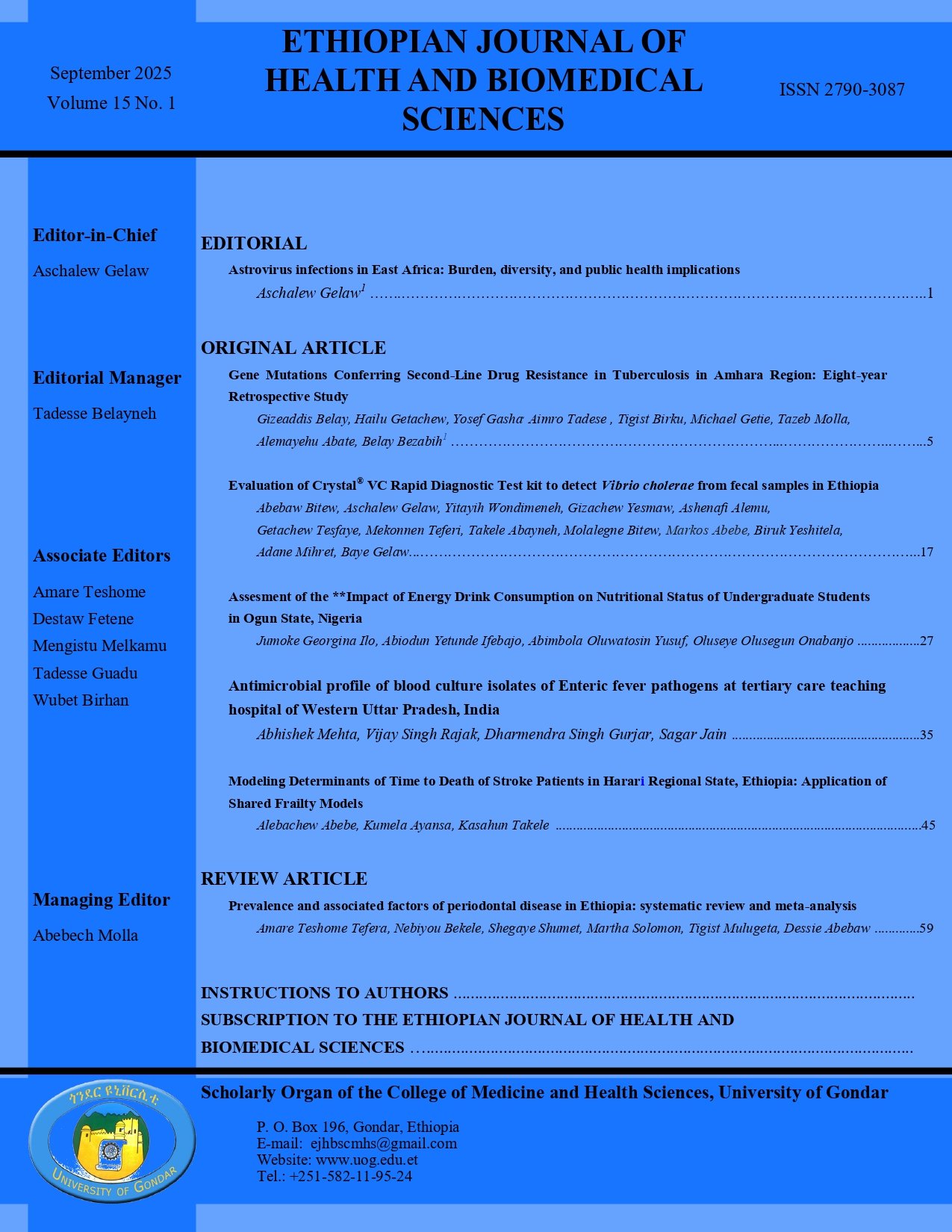
Prevalence and associated factors of periodontal disease in Ethiopia: systematic review and meta-analysis
Background: Periodontal disease, a chronic bacterial infection of the periodontium, is the major cause of tooth loss, masticatory dysfunction, and edentulism. These outcomes adversely affect nutritional status, self-esteem, and quality of life, while also contributing to significant healthcare costs and socio-economic burden. Although oral diseases affect approximately 3.5 billion people globally, with 75% residing in low- and middle -income countries, the national prevalence of periodontal disease in Ethiopia remains undetermined.
Objective: This review aimed to determine the pooled prevalence and associated factors of periodontal disease in Ethiopia.
Method: A systematic search was conducted across PubMed, Scopus, Embase, and Google Scholar to identify relevant studies on periodontal disease in Ethiopia, from inception to April 2023, with no language restrictions. Data were extracted using Microsoft Excel and analyzed in Stata version 17. The pooled prevalence and associated factors were estimated using a random-effects mode due to the high heterogeneity. Heterogeneity was assessed using the Higgs I2 statistic and the Cochrane Q test. Subgroup and sensitivity analyses were conducted to explore source of heterogeneity. The review adhered to the PRISMA guidelines, and the protocol was registered in PROSPERO (CRD42023415994).
Result: Thirteen studies comprising 10,744 participants were included. The pooled prevalence of periodontal disease in Ethiopia was 35% (95% CI: 25% – 45%) with substantial heterogeneity (I2=99.46%). The highest prevalence was reported in Addis Ababa (42%; 95% CI: 29% to 55%) and among institutionalized individuals (49%; 95% CI: 44 – 55%). Regular toothbrushing was associated with lower odds of periodontal disease (OR = 0.26; 95% CI: 0.24 – 0.28), while male gender (OR = 0.72, 95% CI: 0.64 – 0.80) and carbohydrate intake (OR = 0.54, 95% CI: 0.44 – 0.65) were significantly associated with a reduced risk of periodontal disease in Ethiopia.
Conclusion: Periodontal disease affects approximately one in three Ethiopians, with higher prevalence among institutionalized populations. Key determinants include inadequate oral hygiene, female gender, and dietary habits. These findings underscore the need for targeted oral health interventions, including the promotion of regular tooth brushing and dietary modification. National policies should support standardized diagnostic guidelines and integrate oral health services into broader community health programs.
Keywords
Authors
How to Cite
Download Citation
License
Copyright © 2026 The Author(s)

This work is licensed under a Creative Commons Attribution-NonCommercial 4.0 International License.
Similar Articles
- Mebrate Dufera, Hans C.Aass , Nega Berhe , Beyene Petros , Berhanu Erko, Cytokine Response in Mono and Malaria-S. mansoni Co-Infected Individuals in Fincha Sugar Estate, Western Ethiopia , Ethiopian Journal of Health and Biomedical Sciences: Vol. 9 No. 1 (2019)
- Judith P. Cheong-Leen, Abdulmenan Mohammednur, Abdulrahman Tune, Ashebir Nigussie, Afework Amiha, Alemu Girma, Gashaw Messele Messele, Benjamin d.Z. Silverman, Post-Operative Pain and Analgesia at the University of Gondar Hospital , Ethiopian Journal of Health and Biomedical Sciences: Vol. 5 No. 1 (2012)
- Abebaw Bitew, Aschalew Gelaw, Yitayih Wondimeneh, Gizachew Yismaw, Ashenafi Alemu, Getachew esfaye, Mekonnen Teferi, Takele Abayneh, Molalegne Bitew, Markos Abebe, Biruk Yeshitela, Adane Mihret, Baye Gelaw, Evaluation of Crystal® VC Rapid Diagnostic Test kit to detect Vibrio cholerae from fecal samples in Ethiopia , Ethiopian Journal of Health and Biomedical Sciences: Vol. 15 No. 1 (2025)
- Genet Kiflu, Solomon Amsalu, Melkie Edris, Knowledge, Attitude, and Practice of Fgm, Uvulectomy and Extraction of Canine Milk Teeth Follicle among Mothers of Children under the Age of One Living In Gondar Town , Ethiopian Journal of Health and Biomedical Sciences: Vol. 6 No. 1 (2014)
- Hardeep Rai Sharma, Susila Appadurai, Mamo Wubshet, Takele Tadesse, Occupational Exposures and Related Health Effects among Construction Workers , Ethiopian Journal of Health and Biomedical Sciences: Vol. 1 No. 1 (2008)
- Ashenafi Berhanu, Bernard B Anderson, Solomon Yirdaw, Teklu Bekele, Bronchial Carcinoid Tumor and Loculated Tuberculous Empyema Coexisting in the Same Lung: A Case Report , Ethiopian Journal of Health and Biomedical Sciences: Vol. 5 No. 1 (2012)
- Getachew Ferede, Moges Tiruneh, Ebba Abate, Yitayih Wondimeneh, Belay Tessema, Uwe G Liebert, Distribution of Dengue Virus Serotype Based on Neutralization Assay in Northwest Ethiopia , Ethiopian Journal of Health and Biomedical Sciences: Vol. 13 No. 1 (2023)
- Teshome Fetene, Netsanet Worku, Kahsay Huruy, Effect of N-P Fertilizers and Cow Dung on the Larval Development of Mosquitoes in Simulated Field in Alagae, Central Ethiopia , Ethiopian Journal of Health and Biomedical Sciences: Vol. 2 No. 1 (2009)
- Yonas Yilma, Teklu Bekele, Madelung’s Disease: Report of a Case , Ethiopian Journal of Health and Biomedical Sciences: Vol. 2 No. 1 (2009)
- Mizan Kindu, Emergence and spread of carbapenemase producing Gram negative bacteria in Ethiopia: a call for action , Ethiopian Journal of Health and Biomedical Sciences: Vol. 14 No. 2 (2024)
You may also start an advanced similarity search for this article.
Most read articles by the same author(s)
- Dessie Abebaw, Mengistu Berhanu, Ewnetu Genet, Binyam Tilahun, Exploring the Impact of Division of Labor among Health Workforce on Compassionate, Respectful, And Caring Health Professional implementation at Felege-Hiwot Referral Hospital, Amhara Region, North-West Ethiopia , Ethiopian Journal of Health and Biomedical Sciences: Vol. 12 No. 1 (2022)
- Aberham Abere, Abebe Genetu Bayih, Adane Derso, Dessie Abebaw, Ligabaw Worku, Mulugeta Aemero, Schistosoma mansoni in Lake Tana: A comprehensive assessment of parasite, snail vector, and associated factors at Gorgora, Northwest Ethiopia , Ethiopian Journal of Health and Biomedical Sciences: Vol. 13 No. 2 (2023)