
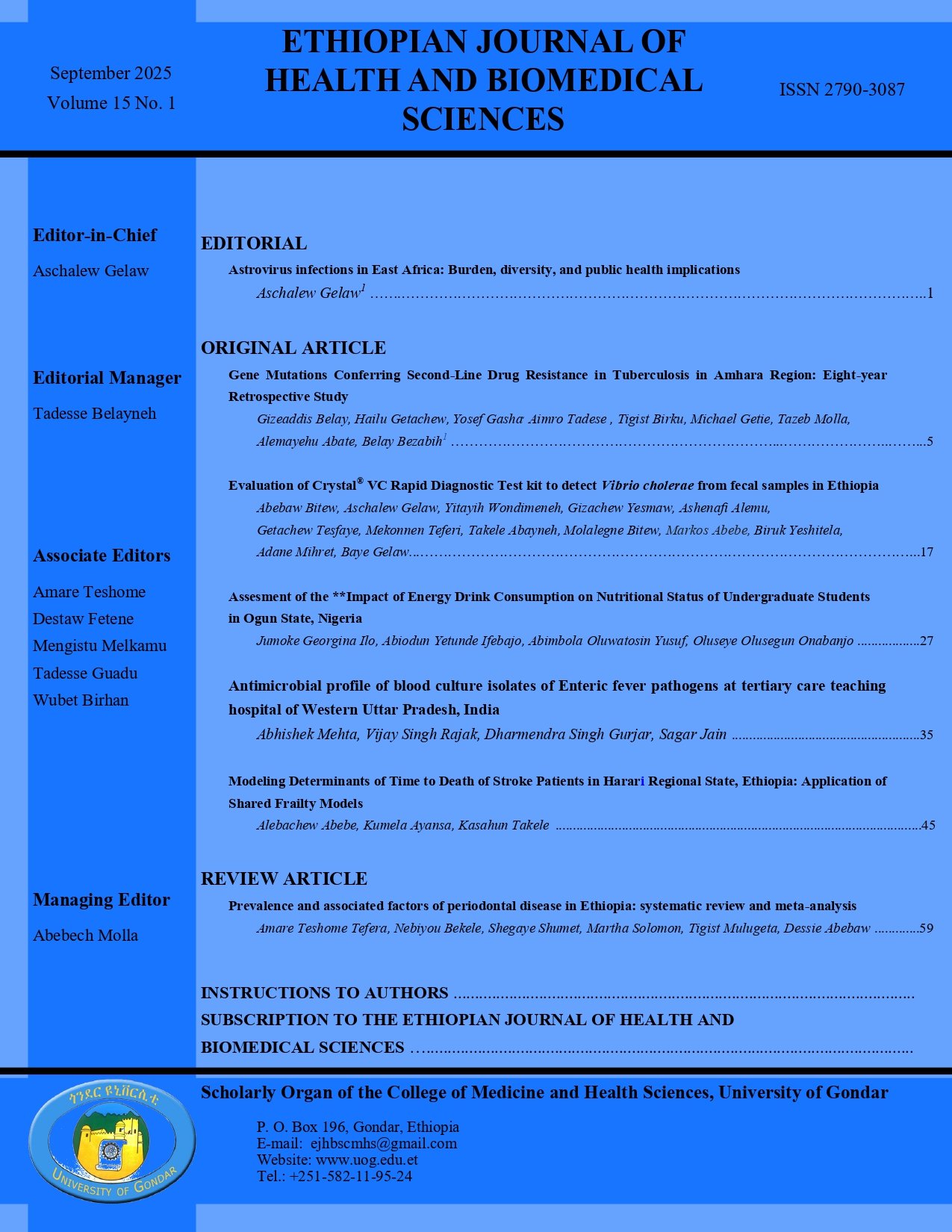
Prevalence and associated factors of periodontal disease in Ethiopia: systematic review and meta-analysis
Background: Periodontal disease, a chronic bacterial infection of the periodontium, is the major cause of tooth loss, masticatory dysfunction, and edentulism. These outcomes adversely affect nutritional status, self-esteem, and quality of life, while also contributing to significant healthcare costs and socio-economic burden. Although oral diseases affect approximately 3.5 billion people globally, with 75% residing in low- and middle -income countries, the national prevalence of periodontal disease in Ethiopia remains undetermined.
Objective: This review aimed to determine the pooled prevalence and associated factors of periodontal disease in Ethiopia.
Method: A systematic search was conducted across PubMed, Scopus, Embase, and Google Scholar to identify relevant studies on periodontal disease in Ethiopia, from inception to April 2023, with no language restrictions. Data were extracted using Microsoft Excel and analyzed in Stata version 17. The pooled prevalence and associated factors were estimated using a random-effects mode due to the high heterogeneity. Heterogeneity was assessed using the Higgs I2 statistic and the Cochrane Q test. Subgroup and sensitivity analyses were conducted to explore source of heterogeneity. The review adhered to the PRISMA guidelines, and the protocol was registered in PROSPERO (CRD42023415994).
Result: Thirteen studies comprising 10,744 participants were included. The pooled prevalence of periodontal disease in Ethiopia was 35% (95% CI: 25% – 45%) with substantial heterogeneity (I2=99.46%). The highest prevalence was reported in Addis Ababa (42%; 95% CI: 29% to 55%) and among institutionalized individuals (49%; 95% CI: 44 – 55%). Regular toothbrushing was associated with lower odds of periodontal disease (OR = 0.26; 95% CI: 0.24 – 0.28), while male gender (OR = 0.72, 95% CI: 0.64 – 0.80) and carbohydrate intake (OR = 0.54, 95% CI: 0.44 – 0.65) were significantly associated with a reduced risk of periodontal disease in Ethiopia.
Conclusion: Periodontal disease affects approximately one in three Ethiopians, with higher prevalence among institutionalized populations. Key determinants include inadequate oral hygiene, female gender, and dietary habits. These findings underscore the need for targeted oral health interventions, including the promotion of regular tooth brushing and dietary modification. National policies should support standardized diagnostic guidelines and integrate oral health services into broader community health programs.
Keywords
Authors
How to Cite
Download Citation
License
Copyright © 2026 The Author(s)

This work is licensed under a Creative Commons Attribution-NonCommercial 4.0 International License.
Similar Articles
- Kassa Birhan, Yigzaw Kebede, Incidence of Tuberculosis and Associated Factors among Patients Attending the HIV Clinic at Felege-Hiwot Referral Hospital, Bahr Dar, Northwest Ethiopia , Ethiopian Journal of Health and Biomedical Sciences: Vol. 6 No. 1 (2014)
- Nahom Worku Teshager, Ashenafi Tazebew Amare, Koku Sissay Tamirat, Kendalem Asmare Atalell, Geta Bayu Genet, The Performance of Modified Pediatric Index of Mortality-2 Scoring System in a Pediatric Intensive Care Unit in Ethiopia , Ethiopian Journal of Health and Biomedical Sciences: Vol. 13 No. 1 (2023)
- Lemma Derseh, Belaynew Wasie, Melkie Edris, Unsafe Sexual Practice among Cross-Border Commercial Sex Workers in Mettema Yohannis, Northwest Ethiopia , Ethiopian Journal of Health and Biomedical Sciences: Vol. 5 No. 1 (2012)
- Shumet Mussa, Desie Kasew, Yitayih Wondimeneh, Seroprevalence of Hepatitis B and C viruses and associated factors among medical waste handlers, Northeast Ethiopia , Ethiopian Journal of Health and Biomedical Sciences: Vol. 12 No. 2 (2022)
- Bayeh Abera, Yeshambel Belyhun, Fantahun Biadegelgen, The Bacteriology of Rhinosinusitis at Felege Hiwot Referral Hospital, Bahir Dar, Ethiopia , Ethiopian Journal of Health and Biomedical Sciences: Vol. 2 No. 2 (2010)
- Dagnew Engdaw, Hameed Sulaiman, Seyoum Leta, Determining the Generation Rate and Composition of Solid Health Care Waste at Gondar University Hospital , Ethiopian Journal of Health and Biomedical Sciences: Vol. 2 No. 1 (2009)
- Eden Bishaw Taye, Dawit Gebeyehu Mekonnen, Tibeb Zena Debele, Knowledge of Postpartum Women about Modern Contraceptive Methods and Attitudes towards its Utilization in Debre Tabor Town, Northwest Ethiopia: A Community-Based Cross-Sectional Study , Ethiopian Journal of Health and Biomedical Sciences: Vol. 13 No. 1 (2023)
- Akeem Olayinka Busari, Nimotallahi Temitope Omoteji, Idris Yahaya Mohammed, Investigation of hepatotoxic effect of cement-dust in occupationally exposed individuals at Malete, Kwara State, North Central Nigeria , Ethiopian Journal of Health and Biomedical Sciences: Vol. 14 No. 2 (2024)
- Wubet Birhan Yigzaw, Belay Tessema, Shu-Hua Wang , Jordi B. Torrelles , Accuracy on Diagnostic Performance of Point Of Care Liodetect® Tb-St Rapid Test for the Diagnosis of Pulmonary Tuberculosis in North West Ethiopia , Ethiopian Journal of Health and Biomedical Sciences: Vol. 11 No. 1 (2021)
- Amezene Tadesse, Berhanu Hailemariam, Right Transverse Testicular Ectopia: A Case Report , Ethiopian Journal of Health and Biomedical Sciences: Vol. 5 No. 1 (2012)
You may also start an advanced similarity search for this article.
Most read articles by the same author(s)
- Dessie Abebaw, Mengistu Berhanu, Ewnetu Genet, Binyam Tilahun, Exploring the Impact of Division of Labor among Health Workforce on Compassionate, Respectful, And Caring Health Professional implementation at Felege-Hiwot Referral Hospital, Amhara Region, North-West Ethiopia , Ethiopian Journal of Health and Biomedical Sciences: Vol. 12 No. 1 (2022)
- Aberham Abere, Abebe Genetu Bayih, Adane Derso, Dessie Abebaw, Ligabaw Worku, Mulugeta Aemero, Schistosoma mansoni in Lake Tana: A comprehensive assessment of parasite, snail vector, and associated factors at Gorgora, Northwest Ethiopia , Ethiopian Journal of Health and Biomedical Sciences: Vol. 13 No. 2 (2023)