
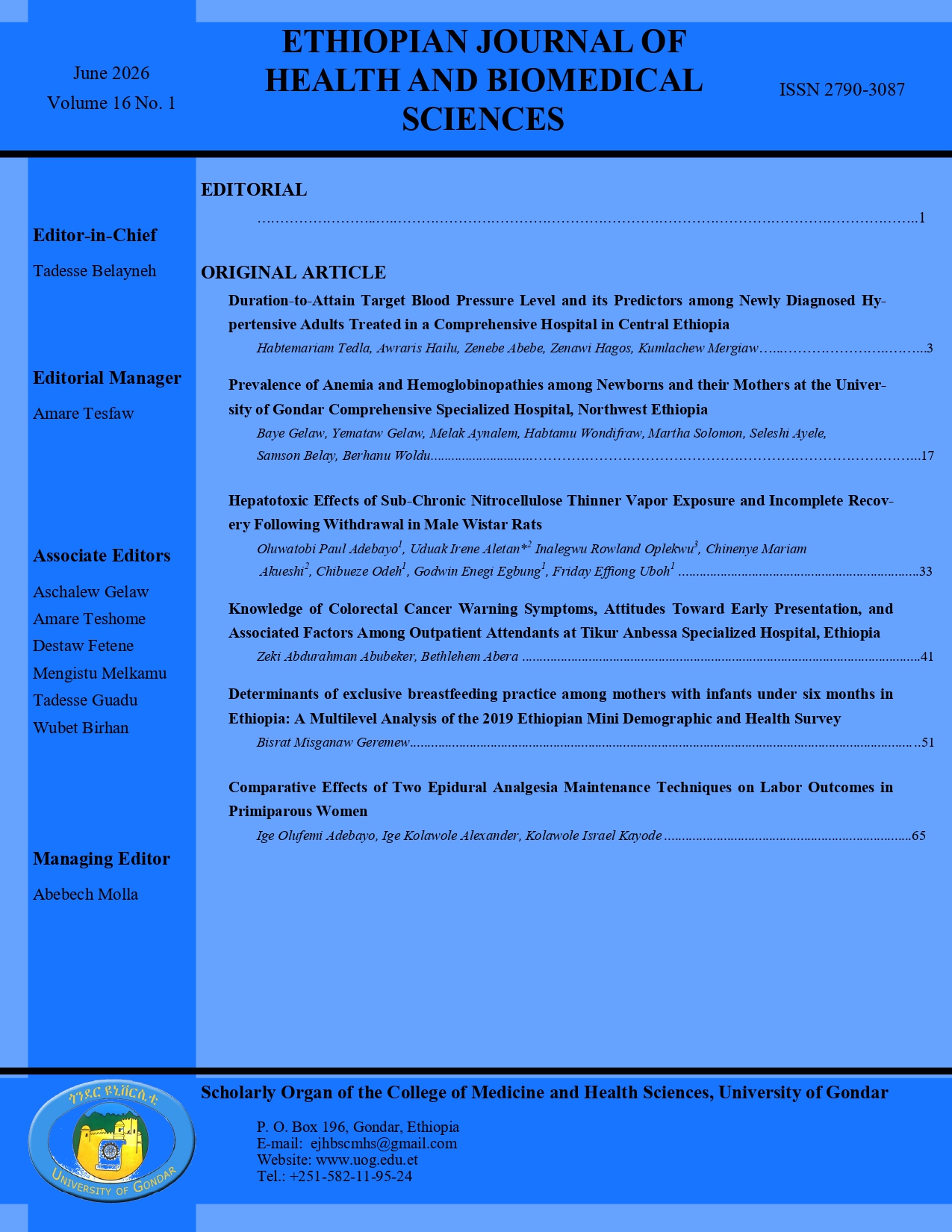
Determinants of exclusive breastfeeding practice among mothers with infants under six months in Ethiopia: A Multilevel Analysis of the 2019 Ethiopian Mini Demographic and Health Survey
Background: Exclusive breastfeeding (EBF) is defined as feeding infants only breast milk, be it directly from the breast or expressed, with no other foods or liquids except prescribed drops or syrups consisting of vitamins, mineral supplements, or medicine. However, the prevalence of exclusive breastfeeding in Ethiopia is lower than that internationally recommended. Most previous studies of EBF in Ethiopia focused on individual-level factors, covered limited geographic areas, used small sample sizes, and relied on binary logistic regression analysis of older datasets. The main objective of this study was to identify the determinants of EBF practice among Ethiopian mothers of infants under 6 months old.
Methods: The 2019 Ethiopian Mini Demographic Health Survey (2019 EMDHS), a recent nationwide community-based cross-sectional survey, was used as the primary source for this study. A multilevel logistic regression model was used to identify significantly associated individual and community-level factors with exclusive breastfeeding among infants under 6 months of age. An adjusted odds ratio (OR) with 95% confidence interval (CI) was used to measure the association of factors with EBF practice. Log-likelihood (LL), deviance, and Akaike information criterion (AIC) were used for model comparison.
Results: A total of 531 weighted infants under 6 months of age in Ethiopia were included in the study. The prevalence of exclusive breastfeeding practice was 83%. Mothers with higher education (AOR: 0.02; 95% CI: 0.001, 0.64) and infants from middle-class or wealthy family backgrounds (AOR: 5.34; 95% CI: 1.022, 27.85) were significantly associated with EBF practice among under-6-month-old infants. Rural residences (AOR: 0.08; 95% CI: 0.01, 0.99), pastoral regions (AOR: 0.03; 95% CI: 0.003, 0.18), and low community poverty level (AOR: 0.11; 95% CI: 0.018, 0.68) were also significantly associated with EBF practice among infants under 6 months old.
Conclusion: In this study, mothers’ educational level, wealth index, place of residence, contextual region, and community poverty level were significant factors affecting EBF practice among infants aged 6 months or less. Creating awareness about poverty and the value of EBF at the community level may help enhance exclusive breastfeeding practices.
Keywords
Authors
How to Cite
Download Citation
License
Copyright © 2026 The Author(s)

This work is licensed under a Creative Commons Attribution-NonCommercial-NoDerivatives 4.0 International License.
Similar Articles
- Gebreamlak Gebremariam , Adino Tesfahun, Assefa Tsegay, Competency Level of Human Resource Management and Associated Factors among Managers in Public Hospitals of Tigray, North Ethiopia , Ethiopian Journal of Health and Biomedical Sciences: Vol. 9 No. 1 (2019)
- Yeterefwork Tsige , Baye Gelaw, Marta Alemayhu, Anteneh Amsalu, The Prevalence Of Methicilin Resistant Staphylococcus Aureus And Associated Risk Factors Among Patients With Wound Infection At Dessie Referral Hospital, Northeast Ethiopia , Ethiopian Journal of Health and Biomedical Sciences: Vol. 8 No. 1 (2017)
- Abiyu Geta, Alemayehu Teklu, Kemal Jemal, Binyam Tilahun, Exploring barriers and enablers of compassionate and respectful care implementation in pre-service education in Ethiopia , Ethiopian Journal of Health and Biomedical Sciences: Vol. 12 No. 1 (2022)
- Getnet Mequanint, Mohammed Birhan , Sodium Hypochlorite Poisoning At the University Of Gondar Teaching Hospital, Northwest Ethiopia , Ethiopian Journal of Health and Biomedical Sciences: Vol. 8 No. 1 (2017)
- Bahiru Tenaw, Abebe Muche, Engidaw Fentahun , Abyot Endale , An Evaluation of Acute and Sub-Acute Toxicity of Methanolic Root Extract Of Myricasalicifolia A. Rich (Myricaceae) On the Histopathology of the Liver, the Kidney and Some Blood Parameters in Swiss Albino Mice , Ethiopian Journal of Health and Biomedical Sciences: Vol. 9 No. 1 (2019)
- Aberham Abere, Abebe Genetu Bayih, Adane Derso, Dessie Abebaw, Ligabaw Worku, Mulugeta Aemero, Schistosoma mansoni in Lake Tana: A comprehensive assessment of parasite, snail vector, and associated factors at Gorgora, Northwest Ethiopia , Ethiopian Journal of Health and Biomedical Sciences: Vol. 13 No. 2 (2023)
- Daniel Jenkin, Ronald Lett, Gashaw Getahun, Mohammed Ali, Surgical Skill, Providers and Infrastructure Needs Assessment in North Gondar, Ethiopia: A Mixed Method Study , Ethiopian Journal of Health and Biomedical Sciences: Vol. 12 No. 2 (2022)
- Alemayehu Abate, Michael Getie, Gizeaddis Belay , Desalew Salew, Prevalence and Antimicrobial Resistance Patterns of Gram-Negative Bacteria at Amhara Public Health Institute, Northwest Ethiopia: A Six-Year Retrospective Study , Ethiopian Journal of Health and Biomedical Sciences: Vol. 15 No. 2 (2025)
- Aschalew Gelaw, Detection of Rotarix Vaccine Viruses in Older Children with Acute Gastroenteritis, Northwest Ethiopia , Ethiopian Journal of Health and Biomedical Sciences: Vol. 11 No. 1 (2021)
- Osman Abdie , Ashenafi Tazebew, Zeleke Mekonnen, Short-Term Outcome of Convulsive Status Epilepticus in Hospital Admitted Children: Etiology and Clinical Feature in North-West Ethiopia , Ethiopian Journal of Health and Biomedical Sciences: Vol. 12 No. 2 (2022)
You may also start an advanced similarity search for this article.