
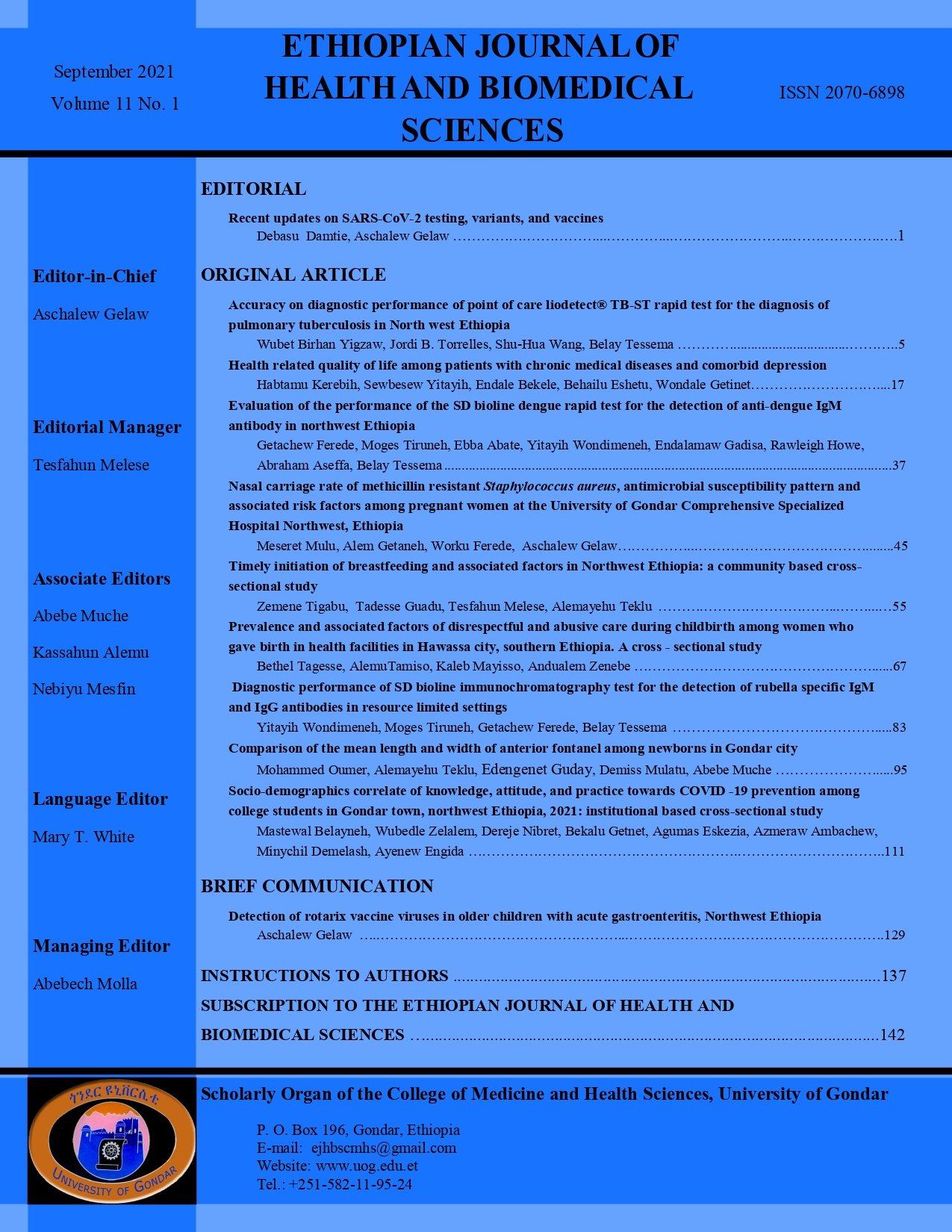
Prevalence and Associated Factors of Disrespectful and Abusive Care during Childbirth among Women Who Gave Birth in Health Facilities in Hawassa City, Southern Ethiopia. A Cross - Sectional Study
Background: There is growing evidence that shows phenomena of disrespect and abuse during childbirth occur globally even though the degree and severity are different across countries. The problem is getting attention in recent years especially in developing countries like Ethiopia. However, there is a paucity of studies assessing the magnitude of disrespectful and abusive care during childbirth.
Objective: This study was undertaken to determine the prevalence and associated factors of disrespectful and abusive care during childbirth in health facilities of Hawassa city, Southern Ethiopia.
Method: A facility-based cross-sectional study was conducted in Hawassa city from February 8 - April 27, 2018. A total of 577 mothers from both public and private health facilities were included. Domains of disrespect and abuse that were assessed were; physical abuse, verbal abuse, stigma and discrimination, failure to meet professional standards of care and poor rapport between women and providers. Binary logistic regression model was used to examine the relationship between exposure and outcome variables. Adjusted odds ratio (AOR) with 95% confidence intervals (CI) was used to determine the association between dependent and independent variables.
Result: Overall 46.9% [95% CI: 42.8-51]of mothers reported experiencing disrespect and abusive care during childbirth in health facilities. The adjusted odds of disrespectful and abusive care among births in public health facilities were 12.9 times higher than birth in private facilities [AOR=12.94 (95% CI: 5.87, 28.50)],mothers who had total delivery four and above had 4.7 times increased odds of encountering disrespect and abusive care [AOR=4.67 95% CI: 1.69, 12.89)].In contrast to mothers who had spontaneous vaginal delivery; mothers who had instrumental delivery had 2.6 times increased chance of encountering disrespect and abusive care [AOR =2.63 (95% CI: 1.05, 6.59)]. Mothers attended by female health providers were 1.75 times more likely to be disrespected and abused than mothers whose delivery was attended by male providers [AOR= 1.75 CI: (1.14, 2.71)].
Conclusion: The prevalence of disrespectful and abusive care during labor and delivery was high in Hawassa city health facilities. Factors associated with disrespectful and abusive care are public health facility, instrumental delivery, parity and sex of health care provider. Therefore, national health strategies and policies should focus on combating disrespect and abuse during maternal care. It is also recommended to give intensive training focusing on respectful maternity care especially in public hospitals by involving more female health care providers.
Keywords
Authors
How to Cite
Download Citation
License
Copyright © 2021 The Author(s)
Similar Articles
- Chalie Tadie, Amsalu Feleke, Ayal Debie, Nursing Process Implementation and Associated Factors among Nurses Working At West Amhara Referral Hospitals , Ethiopian Journal of Health and Biomedical Sciences: Vol. 9 No. 1 (2019)
- Getachew Ferede, Dengue Fever as an Emerging Health Concern in Ethiopia , Ethiopian Journal of Health and Biomedical Sciences: Vol. 9 No. 1 (2019)
- Jemal Ali, Huda Mohammed, Adugna Abera, Yohannes Mengistu, Beverley Singh, Adrian Puren, Dawit Wolday, Comparison of the Bed-Igg Captured EIA HIV-1 Incidence Assay with the Who-Criteria for Identifying Recently HIV Infected Individuals for Enrollment in the HIVDR-TS , Ethiopian Journal of Health and Biomedical Sciences: Vol. 5 No. 1 (2012)
- Mezgebu Yitayal , Yemane Berhane, Alemayehu Worku, Yigzaw Kebede , Graduating Rural Households as Model Families Has Increased Latrine Utilization in West Gojjam Zone, Amhara Region, Ethiopia , Ethiopian Journal of Health and Biomedical Sciences: Vol. 8 No. 1 (2017)
- Osman Abdie , Ashenafi Tazebew, Zeleke Mekonnen, Short-Term Outcome of Convulsive Status Epilepticus in Hospital Admitted Children: Etiology and Clinical Feature in North-West Ethiopia , Ethiopian Journal of Health and Biomedical Sciences: Vol. 12 No. 2 (2022)
- Bogale Desta , Abaineh Munshia, Desalegn Adisu, Alemayehu Abate, Seroprevalence of Hepatitis B Virus Infection among people Living with HIV Attending at the Dangila Health Center, Northwest Ethiopia , Ethiopian Journal of Health and Biomedical Sciences: Vol. 15 No. 2 (2025)
- Adane Kebede, Measho Gebreslassie, Mezgebu Yitayal, Willingness to Enroll For Community-Based Health Insurance and Associated Factors among Household Heads in the Rural Community of Fogera District, Northwest Ethiopia , Ethiopian Journal of Health and Biomedical Sciences: Vol. 10 No. 1 (2020)
- Gebru Gebremeskel Gebrerufael, Bsrat Tesfay Hagos, Predictors of neonatal mortality in Tigray Regional State, Northern Ethiopia: a comparison of parametric survival models’ approaches , Ethiopian Journal of Health and Biomedical Sciences: Vol. 14 No. 1 (2024)
- Tigist Alemu Kassa, Tobias Luck, Marion Michel, Samuel Kinde Birru, Steffi G. Riedel-Heller, Sexual and Reproductive Health Service Utilization among Young Disabled People in Ethiopia: a cross-sectional study , Ethiopian Journal of Health and Biomedical Sciences: Vol. 13 No. 2 (2023)
- Wubet Birhan Yigzaw, Belay Tessema, Shu-Hua Wang , Jordi B. Torrelles , Accuracy on Diagnostic Performance of Point Of Care Liodetect® Tb-St Rapid Test for the Diagnosis of Pulmonary Tuberculosis in North West Ethiopia , Ethiopian Journal of Health and Biomedical Sciences: Vol. 11 No. 1 (2021)
You may also start an advanced similarity search for this article.