
Embedded Implementation Research on Compassionate and Respectful Care Services in the Ethiopian Health System
One of the key factors that distinguish a thriving health care service delivery system is its ability to deliver excellent medical care to its citizens. Compassionate and respectful care (CRC) is very critical for human-centered care and for serving patients ethically and with respect, adhering to a professional oath, and as a model for young professionals (1).Compassion within healthcare has been given growing attention globally over the last decade(2, 3). However, less emphasis has been placed in low resource settings, where little research has been conducted to date (3).
Compassion and respect are fundamental to the higher purpose of the health care system. Compassion can be built in three ways, namely: inquiring about the candidate’s attitudes and beliefs towards compassion at the recruitment stage; providing continuous on-the-job training in compassion skills; and practicing compassion with healthcare staff (4, 5). This reflects the core concept of compassionate care flow, requiring healthcare workers to be supported in this practice by an enabling organizational culture, in order for these values and behaviors to be modeled and enacted (6). The other important aspect of compassionate care is communication. Evidences show that good patient-clinician communication is associated with patients’ better adherence to medication regimen and post-treatment guidelines (7-9). Health workers who adopt a warm, friendly, and reassuring manner are more effective than those who keep consultations formal and do not offer reassurance (10).
The importance of compassion is attested by patients and their families, who consistently rank features of compassion among their greatest healthcare needs(11-14).Patients who are cared for with compassion and kindness are more likely to trust their health care providers and a trusting relationship is crucial for better outcomes. Additionally, compassionate care eases patients’ anxiety and distress, which can help them better cope with pain and discomfort, maintain a positive attitude towards recovery – reflecting in shorter length of hospitalization stay, and comply with post-discharge instructions (15, 16).
Ethiopia’s health policy emphasizes the importance of granting access to a basic package of quality primary health care services to all citizens. The national initiative toward creating compassionate, respectful and caring (CRC) health services was among the four transformation agendas of the 2015-2020 Health Sector Transformation Plan I (HSTP-I) (17) of the Ministry of Health. However, the implementation of the initiative didn’t progress as expected. Hence, evidence was needed to identify what works and what doesn’t using an implementation sciences approach to use the generated evidence as an input in the implementation of the initiative in the new health sector transformation plan running from 2021 to 2025.
Starting in 2021, the Ministry of Health has been collaborating with the University of Gondar and the Alliance for Health Policy and Systems Research of the World Health Organization on an initiative for embedded implementation research on compassionate and respectful care services. The initiative adopts an implementer-led approach to identify, document challenges and learn from best experiences in the implementation of the national strategy to foster CRC services. Collaboration between researchers and implementers was central across all stages of the research process, from defining the research agenda to co-producing the research to discussing the findings and incorporating learning into decision making. Efforts to strengthen local capacity to conduct implementation research were supported by partners throughout the initiative.
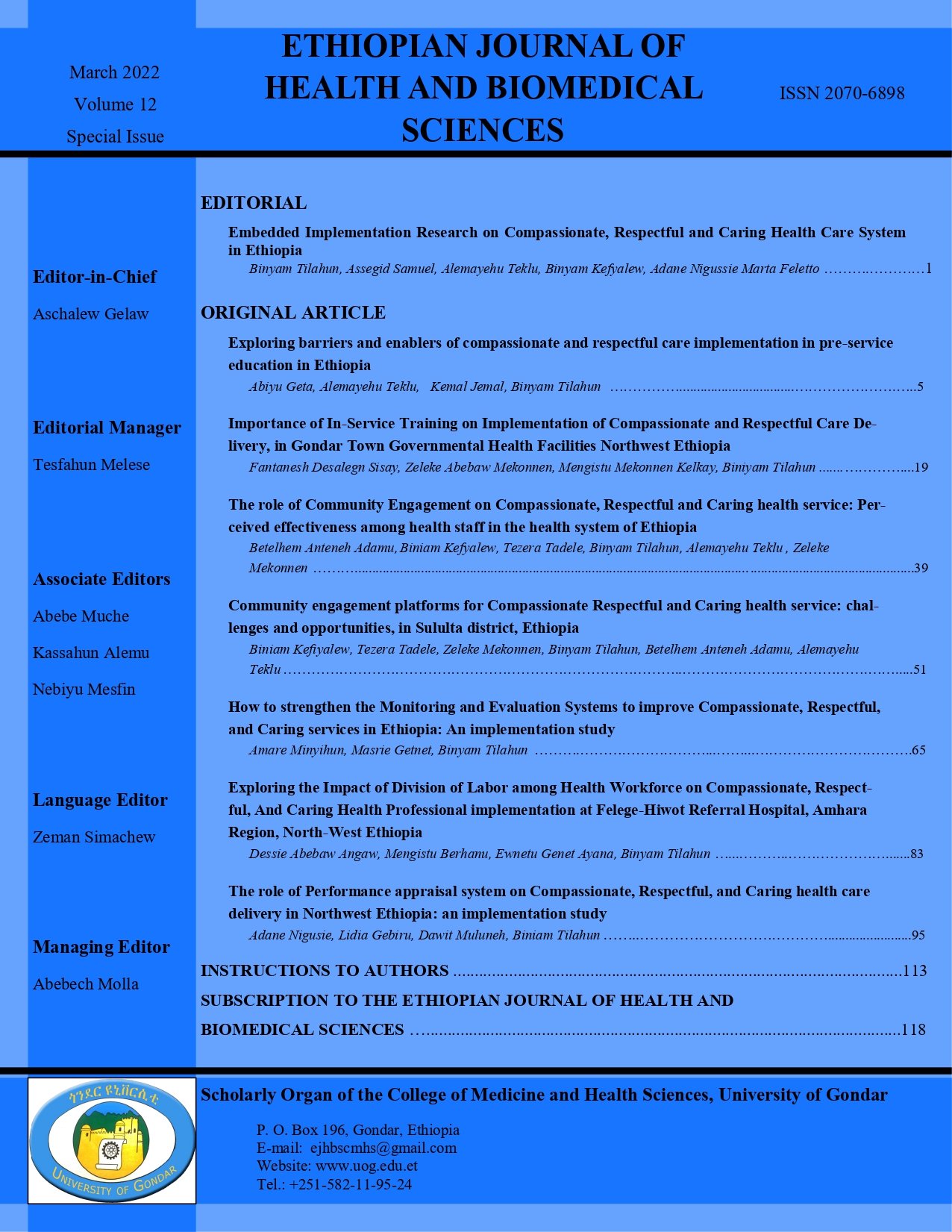
This special issue brings together the findings from the original studies that have been conducted under this initiative, which explore a wide range of issues, from the role and impact of performance appraisal in enhancing CRC to the implementation of CRC in pre-service education as well as in in-service training. Other studies explore the role of community platforms for community engagement in supporting CRC implementation, the status of its monitoring and evaluation, and overarching barriers to and opportunities for strengthening implementation. It is our hope that findings and lessons, as well as recommendations stemming from these studies, will serve to inform the Motivated Competent and Compassionate (MCC) health care system agenda in the Health Sector Transformation Plan II (HSTP-II), and strengthen its implementation.
Authors
How to Cite
Download Citation
License
Copyright © 2022 The Author(s)
Most read articles by the same author(s)
- Amare Minyihun, Masrie Genet, Binyam Tilahun, How to strengthen the Monitoring and Evaluation System to improve Compassionate, Respectful, and Caring services in Ethiopia: An implementation study , Ethiopian Journal of Health and Biomedical Sciences: Vol. 12 No. 1 (2022)
- Fantanesh Desalegn , Zeleke Abebaw , Mengistu Mekonnen, Binyam Tilahun, Importance of CRC In-Service Training on Implementation of Compassionate and Respectful Care Delivery, in Gondar Town Governmental Health Facilities Northwest Ethiopia , Ethiopian Journal of Health and Biomedical Sciences: Vol. 12 No. 1 (2022)
- Adane Nigussie, Lidia Gebiru, Dawit Muluneh, Binyam Tilahun, The role of Performance appraisal system on Compassionate, Respectful, and Caring health care delivery in Northwest Ethiopia: an implementation study , Ethiopian Journal of Health and Biomedical Sciences: Vol. 12 No. 1 (2022)
- Biniam Kefiyalew, Tezera Tadele, Zeleke Mekonnen, Binyam Tilahun, Bethelhem Anteneh, Alemayehu Teklu, Community engagement platforms for Compassionate Respectful and Caring health service: challenges and opportunities, in Sululta district, Ethiopia , Ethiopian Journal of Health and Biomedical Sciences: Vol. 12 No. 1 (2022)
- Bethelhem Anteneh, Biniam Kefyalew, Tezera Tadele, Binyam Tilahun, Alemayehu Teklu, Zeleke Mekonnen, The role of Community Engagement on Compassionate, Respectful and Caring health service: Perceived effectiveness among health staff in the health system of Ethiopia , Ethiopian Journal of Health and Biomedical Sciences: Vol. 12 No. 1 (2022)
- Abiyu Geta, Alemayehu Teklu, Kemal Jemal, Binyam Tilahun, Exploring barriers and enablers of compassionate and respectful care implementation in pre-service education in Ethiopia , Ethiopian Journal of Health and Biomedical Sciences: Vol. 12 No. 1 (2022)
- Habtamu Guadie, Berhanu Fikadie, Tesfahun Yilma, Binyam Tilahun, Digital Readiness for eConsultation towards the COVID-19 pandemic among Health Professionals: Northwest, Ethiopia , Ethiopian Journal of Health and Biomedical Sciences: Vol. 12 No. 2 (2022)
- Dessie Abebaw, Mengistu Berhanu, Ewnetu Genet, Binyam Tilahun, Exploring the Impact of Division of Labor among Health Workforce on Compassionate, Respectful, And Caring Health Professional implementation at Felege-Hiwot Referral Hospital, Amhara Region, North-West Ethiopia , Ethiopian Journal of Health and Biomedical Sciences: Vol. 12 No. 1 (2022)
- Zemene Tigabu, Tadesse Guadu, Tesfahun Melese, Alemayehu Teklu, Timely Initiation of Breastfeeding and Associated Factors in Northwest Ethiopia: A Community Based Cross-Sectional Study , Ethiopian Journal of Health and Biomedical Sciences: Vol. 11 No. 1 (2021)
- Mohammed Oumer, Alemayehu Teklu , Edengenet Guday, Demiss Mulatu Geberu, Abebe Muche, Comparison of the Mean Length and Width of Anterior Fontanel among Newborns in Gondar City , Ethiopian Journal of Health and Biomedical Sciences: Vol. 11 No. 1 (2021)