
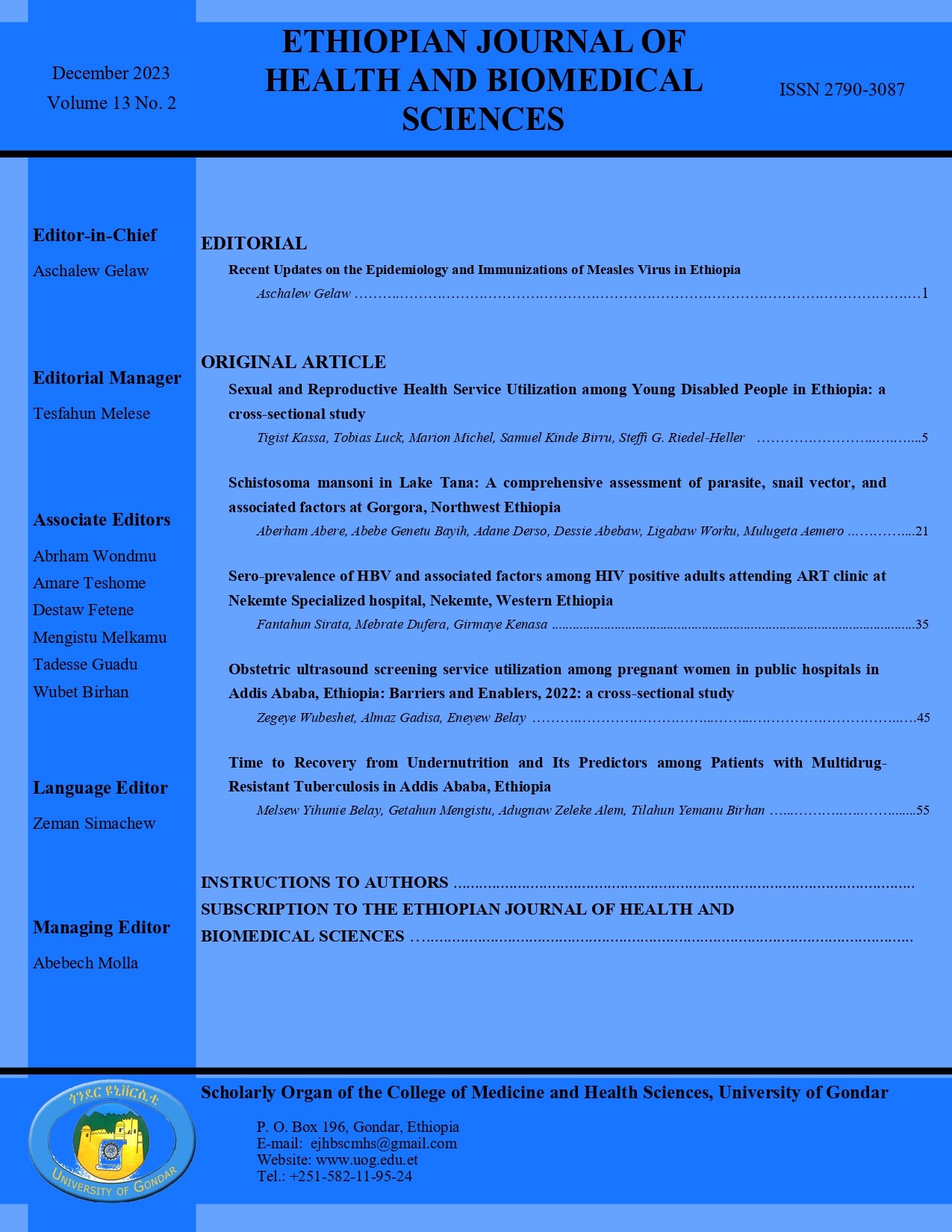
Sexual and Reproductive Health Service Utilization among Young Disabled People in Ethiopia: a cross-sectional study
Background: In Ethiopia, the delivery of sexual and reproductive health services (SRHSs) to young people with disability (YPWD) is poorly understood, as such they are often marginalized and not recognized as being sexual. This study, therefore, aimed to assess the sexual and reproductive health service utilization and associated factors among young people with disability in Ethiopia.
Methods: In 2012, a cross-sectional survey was conducted in Addis Ababa, Ethiopia; 426 young people with disability aged 10-24 years were systematically selected and included in the study. Data were collected by trained interviewers using a standardized questionnaire and analyzed using Predictive Analytics Software (PASW), version 20. All analyses used an alpha level of 0.05 (two-tailed) to determine statistical significance.
Results: Only one-fourth of the young people with disability (26.1%) had ever utilized sexual and reproductive health services. The most commonly cited reasons for seeking sexual and reproductive health services were to get contraceptives (48.1%), to get condoms (21.2%), and for HIV counseling and testing (21.2%). Sixty-three percent of the sexually active young people with disability had ever used a modern contraceptive method, and 54.3% had ever used a condom. Fifty-six percent of the participants had ever been tested for HIV. Being older, female, and literate were found to be important putative determinants of sexual and reproductive health service use according to logistic regression analysis. The main reasons for not utilizing sexual and reproductive health services were the inconvenience of health institutions (48.8%) followed by poor handling and scolding by the service provider (22.1%).
Conclusions: This study revealed that many young people with disability in Ethiopia experience barriers to access sexual and reproductive health services, particularly due to inconvenient health institutions and poor handling by service providers. Not surprisingly, education plays an important role in sexual and reproductive health service use. However, the higher likelihood of using sexual and reproductive health services by older females, as in our study, could be evidence of a societal misconception that SRHSs are only for adults and women. It could also be an indication of the increased risk of females for sexual and reproductive health problems and the increased vulnerability associated with a lack of access to sexual and reproductive health services for younger people with disability. Therefore, an effort has to be made by program and policymakers, and other concerned parties to raise disability-related awareness at the societal level to foster respect for the rights and dignity of persons with disabilities. There is also a need to intervene on the available and upcoming sexual and reproductive health services and programs to make them youth and disability friendly.
Keywords
Authors
How to Cite
Download Citation
License
Copyright © 2023 The Author(s)

This work is licensed under a Creative Commons Attribution-NonCommercial 4.0 International License.
Similar Articles
- Getu Degu Alene, Harmful Traditional Health Practices: A Cross – Sectional Survey among Under-Five Children in Dembia District, North-West Ethiopia , Ethiopian Journal of Health and Biomedical Sciences: Vol. 2 No. 2 (2010)
- Getachew Belay, Mulat Dagnew, Awgechaw Ketema, Habtalem Mequanint, Alebachew Fasil, Belete Biadgo, Habtamu Wondifraw, Teklay Gebrecherkos, Diagnostic Performance Of Reagent Strips And Microscopy For The Diagnosis Of Urinary Tract Infection Among Pregnant Women At the University Of Gondar Comprehensive Specialized Hospital, Northwest Ethiopia A Cross Sectional Study , Ethiopian Journal of Health and Biomedical Sciences: Vol. 9 No. 1 (2019)
- Biniam Kefiyalew, Tezera Tadele, Zeleke Mekonnen, Binyam Tilahun, Bethelhem Anteneh, Alemayehu Teklu, Community engagement platforms for Compassionate Respectful and Caring health service: challenges and opportunities, in Sululta district, Ethiopia , Ethiopian Journal of Health and Biomedical Sciences: Vol. 12 No. 1 (2022)
- Mengistu Endris, Getasew Walle, Belaynew Wassie, Mulugeta Aemiro, Ligabaw Worku, Simon G/tsadik, Takele Teklu, Wubet Birhan, Jemal Ali, Bemnet Amare, Martha Alemayehu, Belay Anagaw, Aschalew Gelaw, Beyene Moges, Yeshambel Belyhun, Wossenseged Lemma, Meseret Delelegn, Prevalence of Intestinal Parasites and Associated Risk Factors among Students of Atse Fasil General Elementary School Azezo, Northwest Ethiopia , Ethiopian Journal of Health and Biomedical Sciences: Vol. 3 No. I (2010)
- Fantahun Sirata, Mebrate Dufera, Girmaye Kenasa, Sero-prevalence of HBV and associated factors among HIV positive adults attending ART clinic at Nekemte Specialized hospital, Nekemte, Western Ethiopia , Ethiopian Journal of Health and Biomedical Sciences: Vol. 13 No. 2 (2023)
- Dessie Abebaw, Mengistu Berhanu, Ewnetu Genet, Binyam Tilahun, Exploring the Impact of Division of Labor among Health Workforce on Compassionate, Respectful, And Caring Health Professional implementation at Felege-Hiwot Referral Hospital, Amhara Region, North-West Ethiopia , Ethiopian Journal of Health and Biomedical Sciences: Vol. 12 No. 1 (2022)
- Zegeye Wubeshet Haile, Almaz Gadisa, Eneyew Belay, Obstetric ultrasound screening service utilization among pregnant women in public hospitals in Addis Ababa, Ethiopia: Barriers and Enablers, 2022: a cross-sectional study , Ethiopian Journal of Health and Biomedical Sciences: Vol. 13 No. 2 (2023)
- Yitayih Wondimeneh, Rubella Associated Maternal and Child Health Problems in the Vaccine Era , Ethiopian Journal of Health and Biomedical Sciences: Vol. 10 No. 1 (2020)
- Yesuf Adem, Abebe Muche, Prevalence of Intestinal Parasites in Metema District Hospital, Northwest Ethiopia , Ethiopian Journal of Health and Biomedical Sciences: Vol. 2 No. 2 (2010)
- Gizeaddis Belay Mersha, Hailu Getachew, Yosef Getachew, Aimro Tadese, Tigist Birku, Michael Gete, Tazeb Molla, Alemayehu Abate, Belay Bezabih, Gene Mutations Conferring for Second-Line Drug-resistant Tuberculosis in Amhara Region: Eight-years Retrospective Study , Ethiopian Journal of Health and Biomedical Sciences: Vol. 15 No. 1 (2025)
You may also start an advanced similarity search for this article.