
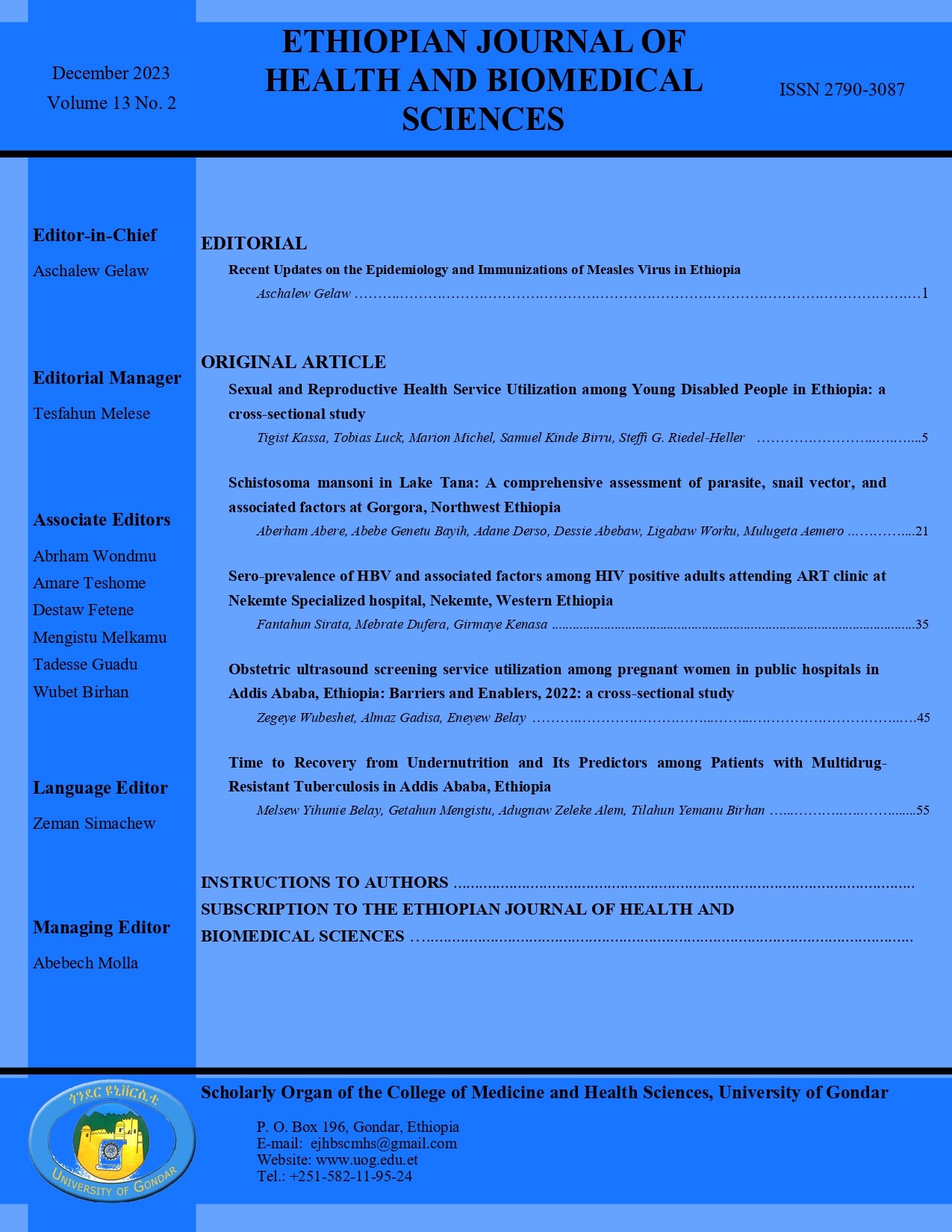
Sexual and Reproductive Health Service Utilization among Young Disabled People in Ethiopia: a cross-sectional study
Background: In Ethiopia, the delivery of sexual and reproductive health services (SRHSs) to young people with disability (YPWD) is poorly understood, as such they are often marginalized and not recognized as being sexual. This study, therefore, aimed to assess the sexual and reproductive health service utilization and associated factors among young people with disability in Ethiopia.
Methods: In 2012, a cross-sectional survey was conducted in Addis Ababa, Ethiopia; 426 young people with disability aged 10-24 years were systematically selected and included in the study. Data were collected by trained interviewers using a standardized questionnaire and analyzed using Predictive Analytics Software (PASW), version 20. All analyses used an alpha level of 0.05 (two-tailed) to determine statistical significance.
Results: Only one-fourth of the young people with disability (26.1%) had ever utilized sexual and reproductive health services. The most commonly cited reasons for seeking sexual and reproductive health services were to get contraceptives (48.1%), to get condoms (21.2%), and for HIV counseling and testing (21.2%). Sixty-three percent of the sexually active young people with disability had ever used a modern contraceptive method, and 54.3% had ever used a condom. Fifty-six percent of the participants had ever been tested for HIV. Being older, female, and literate were found to be important putative determinants of sexual and reproductive health service use according to logistic regression analysis. The main reasons for not utilizing sexual and reproductive health services were the inconvenience of health institutions (48.8%) followed by poor handling and scolding by the service provider (22.1%).
Conclusions: This study revealed that many young people with disability in Ethiopia experience barriers to access sexual and reproductive health services, particularly due to inconvenient health institutions and poor handling by service providers. Not surprisingly, education plays an important role in sexual and reproductive health service use. However, the higher likelihood of using sexual and reproductive health services by older females, as in our study, could be evidence of a societal misconception that SRHSs are only for adults and women. It could also be an indication of the increased risk of females for sexual and reproductive health problems and the increased vulnerability associated with a lack of access to sexual and reproductive health services for younger people with disability. Therefore, an effort has to be made by program and policymakers, and other concerned parties to raise disability-related awareness at the societal level to foster respect for the rights and dignity of persons with disabilities. There is also a need to intervene on the available and upcoming sexual and reproductive health services and programs to make them youth and disability friendly.
Keywords
Authors
How to Cite
Download Citation
License
Copyright © 2023 The Author(s)

This work is licensed under a Creative Commons Attribution-NonCommercial 4.0 International License.
Similar Articles
- Yemataw Wondie, Yusuf Omer Abdi, Child Sexual Abuse and Its Psychosocial Effects on Female Children in Addis Ababa , Ethiopian Journal of Health and Biomedical Sciences: Vol. 1 No. 1 (2008)
- Yeterefwork Tsige , Baye Gelaw, Marta Alemayhu, Anteneh Amsalu, The Prevalence Of Methicilin Resistant Staphylococcus Aureus And Associated Risk Factors Among Patients With Wound Infection At Dessie Referral Hospital, Northeast Ethiopia , Ethiopian Journal of Health and Biomedical Sciences: Vol. 8 No. 1 (2017)
- Hardeep Rai Sharma, Susila Appadurai, Mamo Wubshet, Takele Tadesse, Occupational Exposures and Related Health Effects among Construction Workers , Ethiopian Journal of Health and Biomedical Sciences: Vol. 1 No. 1 (2008)
- Bahiru Tenaw, Abebe Muche, Engidaw Fentahun , Abyot Endale , An Evaluation of Acute and Sub-Acute Toxicity of Methanolic Root Extract Of Myricasalicifolia A. Rich (Myricaceae) On the Histopathology of the Liver, the Kidney and Some Blood Parameters in Swiss Albino Mice , Ethiopian Journal of Health and Biomedical Sciences: Vol. 9 No. 1 (2019)
- Melsew Yihunie Belay, Getahun Mengistu, Adugnaw Zeleke Alem, Tilahun Yemanu Birhan, Time to Recovery from Undernutrition and Its Predictors among Patients with Multidrug-Resistant Tuberculosis in Addis Ababa, Ethiopia , Ethiopian Journal of Health and Biomedical Sciences: Vol. 13 No. 2 (2023)
- Amare Teshome Tefera, Nebiyou Bekele, Shegaye Shumet, Martha Solomon, Tigist Mulugeta, Dessie Abebaw, Prevalence and associated factors of periodontal disease in Ethiopia: systematic review and meta-analysis , Ethiopian Journal of Health and Biomedical Sciences: Vol. 15 No. 1 (2025)
- Gashaw Messele, Yeshi Woldemedhin, Motuma Demissie, Kidanemariam Mamo, Aberra Geyid, Common Causes of Nosocomial Infections and Their Susceptibility Patterns in Two Hospitals in Addis Ababa , Ethiopian Journal of Health and Biomedical Sciences: Vol. 2 No. 1 (2009)
- Gashaw Asnakew, Endale Tefera, Pattern of Childhood Epilepsy and Outcome Determinants at Tikur Anbessa Specialized Hospital, Addis Ababa, Ethiopia , Ethiopian Journal of Health and Biomedical Sciences: Vol. 5 No. 1 (2012)
- Wubet Birhan Yigzaw, Belay Tessema, Shu-Hua Wang , Jordi B. Torrelles , Accuracy on Diagnostic Performance of Point Of Care Liodetect® Tb-St Rapid Test for the Diagnosis of Pulmonary Tuberculosis in North West Ethiopia , Ethiopian Journal of Health and Biomedical Sciences: Vol. 11 No. 1 (2021)
- Mequanint Bezie, Moges Tiruneh, Belay Anagaw, Mulat Dagnew, Bacterial Causes of Acute Febrile Illnesses and Their Antimicrobial Susceptibility Patterns in Adult Patients Attending Felege-Hiwot Referral Hospital, Northwest Ethiopia: A Cross Sectional Study , Ethiopian Journal of Health and Biomedical Sciences: Vol. 8 No. 1 (2017)
You may also start an advanced similarity search for this article.