
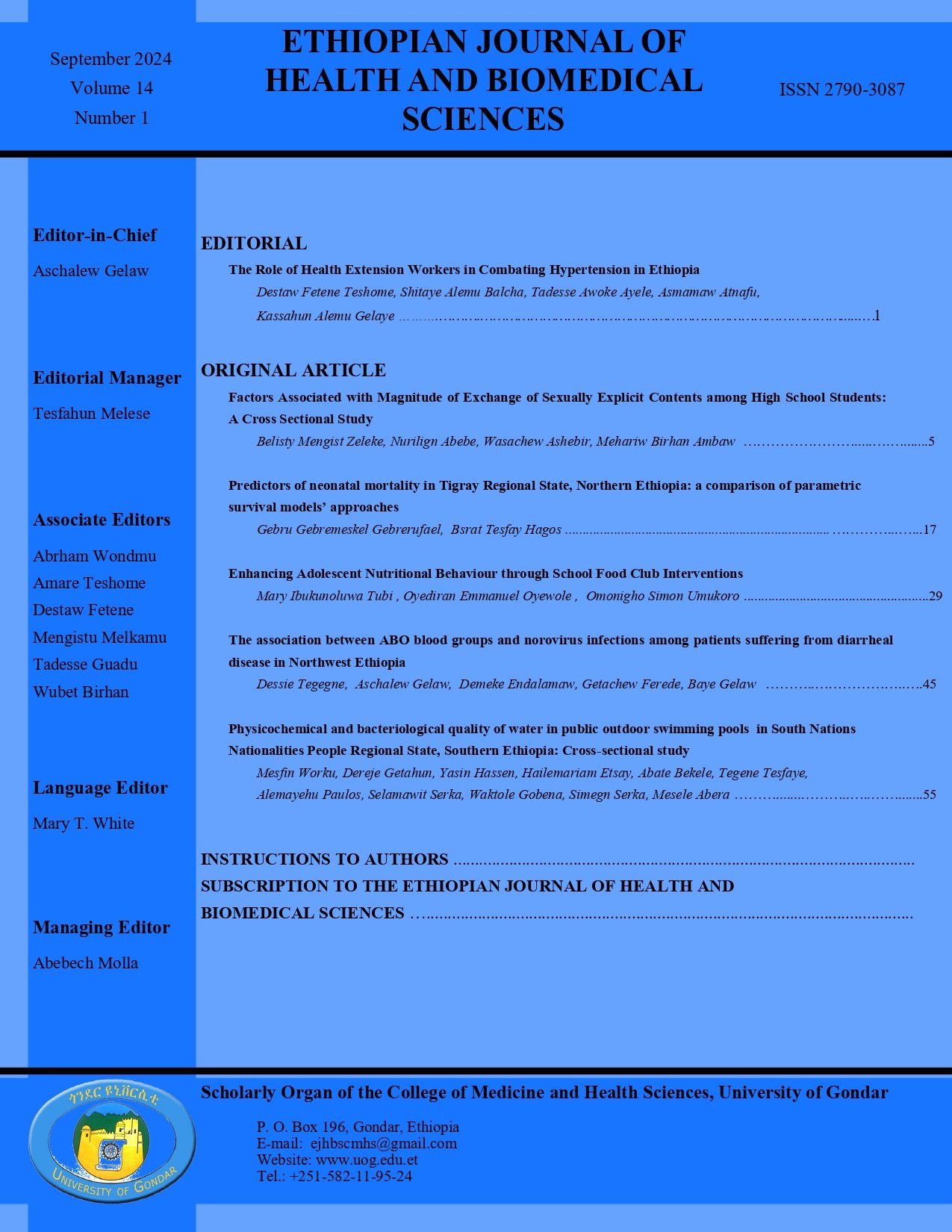
Factors associated with magnitude of exchange of sexually explicit contents among high school students: a cross sectional study
Background: “Exchange of sexually explicit content” refers to behaviors such as sending or receiving nude or partially nude images, and sexually suggestive texts and calls via cell phones or other electronic media. As mobile technology is increasingly used to form and maintain social relationships, sexual content-sharing practices are becoming common among young people, contributing to technology-driven sexual risks. Despite this prevalence, there is a paucity of evidence on the prevalence of sexually explicit content-sharing among high school students.
Objective: This study aims to assess the magnitude of exchange of sexually explicit materials and associated risk factors among high school students.
Method: A cross-sectional study design using a stratified sampling technique was employed applied to 590 students from April 18, 2022 to May 03, 2022. Data was collected through structured, self-administered questionnaire. Data were coded and entered into Epi-Data version 3.1 and exported to SPSS version 25 for analysis. The degree of association between dependent and independent variables was assessed using bivariable and multivariable logistic regression analysis. Variables with p-value of less than 0.05 were considered significant.
Result: Overall about 220(38.4%) (95% CI 34.4-42.5) of high school students were actively engaged in exchange of sexually explicit contents. Associated factors were being male (AOR=2.08, 95%CI 1.37, 3.16), being in grade 12 (AOR=3.29, 95%CI1.84, 5.89), living with mother (AOR=7.49, 95%CI 4.01, 14.01), living with father (AOR= 7.06,95% CI2.99,16.66), having a social media account (AOR=3.35, 95%CI1.87, 6.07), free internet access (AOR=2.29,95%CI1.49,3.49) and having a low religiosity scale (AOR=1.67, 95% CI1.10, 2.54).
Conclusion: This study indicated that being male, having a low religiosity scale, living with a single parent, and visiting variety of social media were the major predictors associated with exchange of sexually explicit contents in Debre Markos high school students. There is a vital need to inform students of the consequences of this behavior on sexual health. Guardians or parents should strengthen their child’s religious faith and parent their children together instead of individually. The purpose of information communication technology (ICT) materials in schools should be clearly explained to the students as being for the sole purpose of information gathering and not for illicit purpose.
Authors
How to Cite
Download Citation
License
Copyright © 2024 The Author(s)

This work is licensed under a Creative Commons Attribution-NonCommercial 4.0 International License.