
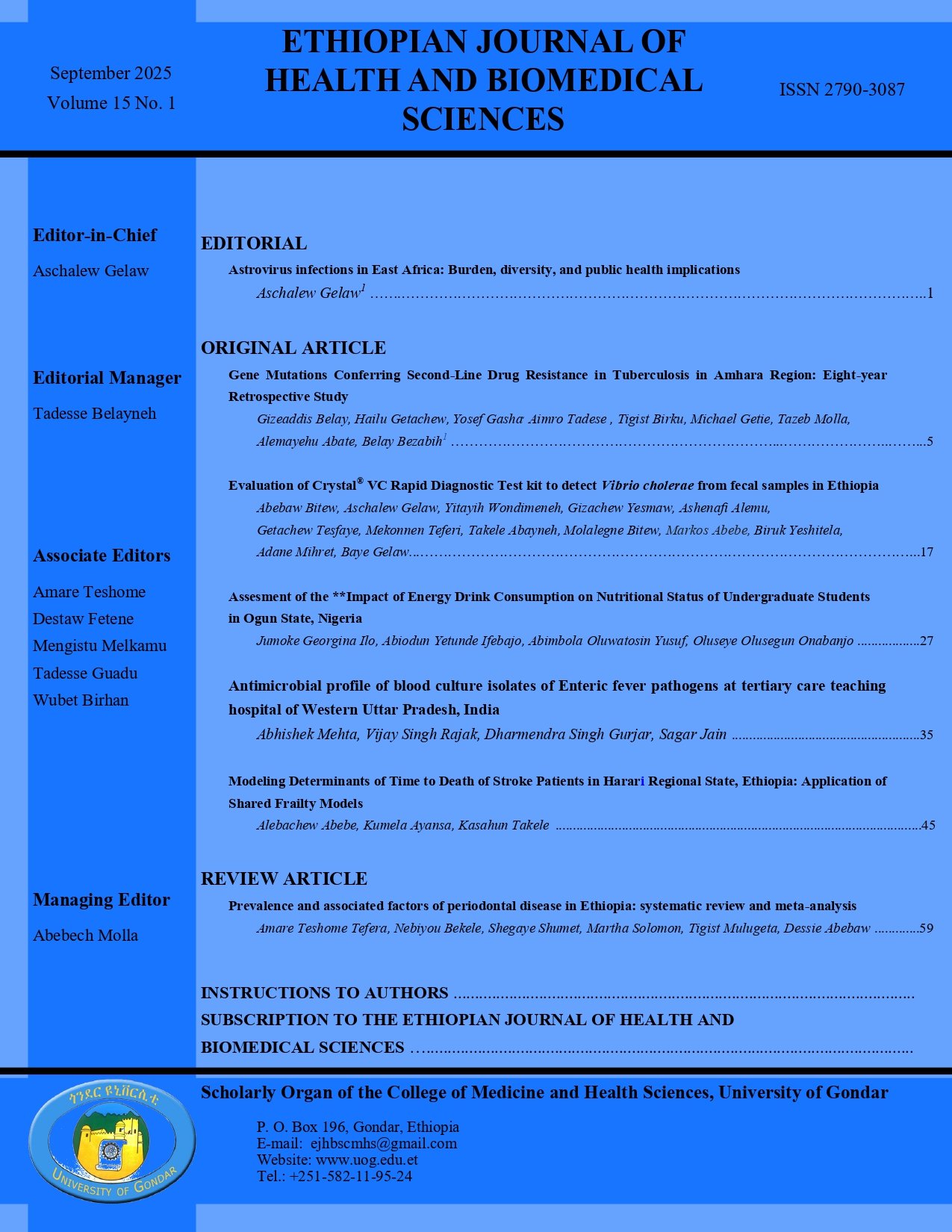
Modeling Determinants of Time to Death of Stroke Patients at Harar Regional State, Ethiopia: Application of Shared Frailty Models
Background: Stroke, a condition caused by interrupted blood flow to the brain, is the second leading cause of death worldwide and a major contributor to morbidity and disability. Despite its global impact, there remains a need for more comprehensive and flexible statistical models to better understand the timing of stroke-related mortality. This study addressed this gap by applying robust shared frailty models to stroke patient data.
Objective: The main purpose of this study was to identify the factors influencing time to death among stroke patients using shared frailty models, accounting for hospital-level clustering effects.
Methods: A retrospective study was conducted at Harar Regional State, Ethiopia, across three hospitals: Harar General Hospital, Jegol hospital, and Hiwot Fana Specialized University Hospital. A total of 224 stroke patients admitted to medical wards between September 1, 2020, and November 1, 2023, were included. Data was coded, cleaned, and entered in to SPSS version 25 and further analyzed using R-Studio. The presence of clustering (frailty) effects among hospitals was evaluated, and different shared frailty models were compared to identify the best-fitting model.
Results: Of the total 224 stroke patients, 51(22.77%) died during the study period, while 173 (77.23%) were censored. The median survival time was estimated at 14 days, highlighting the acute nature of the disease. The Weibull-inverse Gaussian shared frailty model provided the best fit for the data, accounting for unobserved heterogeneity across hospitals. Significant predictors of shorter time to death included hypertension (φ = 2.118; 95% CI: 1.145-3.917), cardiac disease (φ = 2.667; 95% CI: 1.343-5.296), diabetes mellitus (φ = 3.035; 95% CI: 1.1.560-5.906), atrial fibrillation (φ = 3.247; 95% CI: 1.619-6.511), and presence of basic complications (φ = 2.983; 95% CI: 1.477-6.023).
Conclusion: This study highlights the importance of hospital-level clustering effects in survival analysis of stroke patients. The significant frailty effect suggests variability in outcomes across hospitals, underlining the need for tailored interventions. Clinicians and hospital administrators should consider these differences when managing stroke patients, emphasizing timely follow-up, individualized care, and resource allocation to improve survival outcomes.
Keywords
Authors
How to Cite
Download Citation
License
Copyright © 2026 The Author(s)

This work is licensed under a Creative Commons Attribution-NonCommercial 4.0 International License.
Similar Articles
- Sintayehu Tseha, Yalemtsehay Mekonnen, Asnake Desalegn, Mesfin Tadesse, Paulos Getachew, Melaku Wondafarsh, Antioxidant activity of the leaves extracts of Boscia coriacea Graells and Uvaria leptocladon Oliv , Ethiopian Journal of Health and Biomedical Sciences: Vol. 14 No. 2 (2024)
- Shumet Mussa, Desie Kasew, Yitayih Wondimeneh, Seroprevalence of Hepatitis B and C viruses and associated factors among medical waste handlers, Northeast Ethiopia , Ethiopian Journal of Health and Biomedical Sciences: Vol. 12 No. 2 (2022)
- Alemayehu Bishaw, Comparison of Process-Based and Traditional Approaches in Developing Students’ Knowledge and Attitude towards the Prevention of HIV/AIDS in Gimijabet Elementary School , Ethiopian Journal of Health and Biomedical Sciences: Vol. 3 No. I (2010)
- Habtamu Guadie, Berhanu Fikadie, Tesfahun Yilma, Binyam Tilahun, Digital Readiness for eConsultation towards the COVID-19 pandemic among Health Professionals: Northwest, Ethiopia , Ethiopian Journal of Health and Biomedical Sciences: Vol. 12 No. 2 (2022)
- Berihun Megabiaw , Belaynew Wasie, Nikki L. Rogers, Malnutrition among HIV-Positive Children at Two Referral Hospitals in Northwest Ethiopia , Ethiopian Journal of Health and Biomedical Sciences: Vol. 5 No. 1 (2012)
- Haregewoin Mulat, Equlinet Misgenaw, Haddis Solomon, Public Knowledge and Attitude Towards Mental Illness And Mentally Challenging People In Gondar Town, Northwest Ethiopia, 2011 , Ethiopian Journal of Health and Biomedical Sciences: Vol. 9 No. 1 (2019)
- Genet Kiflu, Solomon Amsalu, Melkie Edris, Knowledge, Attitude, and Practice of Fgm, Uvulectomy and Extraction of Canine Milk Teeth Follicle among Mothers of Children under the Age of One Living In Gondar Town , Ethiopian Journal of Health and Biomedical Sciences: Vol. 6 No. 1 (2014)
- Alebachew Tadie, Atalay Getachew, Physico-Chemical Properties of Water from Kaha River, In Gondar Town, Ethiopia , Ethiopian Journal of Health and Biomedical Sciences: Vol. 10 No. 1 (2020)
- Feleke Moges, Moges Tiruneh, Feleke Moges, Yeshambel Belyhun, Yenew Kebede, Andargachew Mulu, Afework Kassu, Intestinal Parasitic Infections in Association with Cutaneous Fungal Infection and Nutritional Status among Tseda School Children, Northwest Ethiopia , Ethiopian Journal of Health and Biomedical Sciences: Vol. 3 No. I (2010)
- Ashenafi Berhanu, Bernard B Anderson, Solomon Yirdaw, Teklu Bekele, Bronchial Carcinoid Tumor and Loculated Tuberculous Empyema Coexisting in the Same Lung: A Case Report , Ethiopian Journal of Health and Biomedical Sciences: Vol. 5 No. 1 (2012)
You may also start an advanced similarity search for this article.