
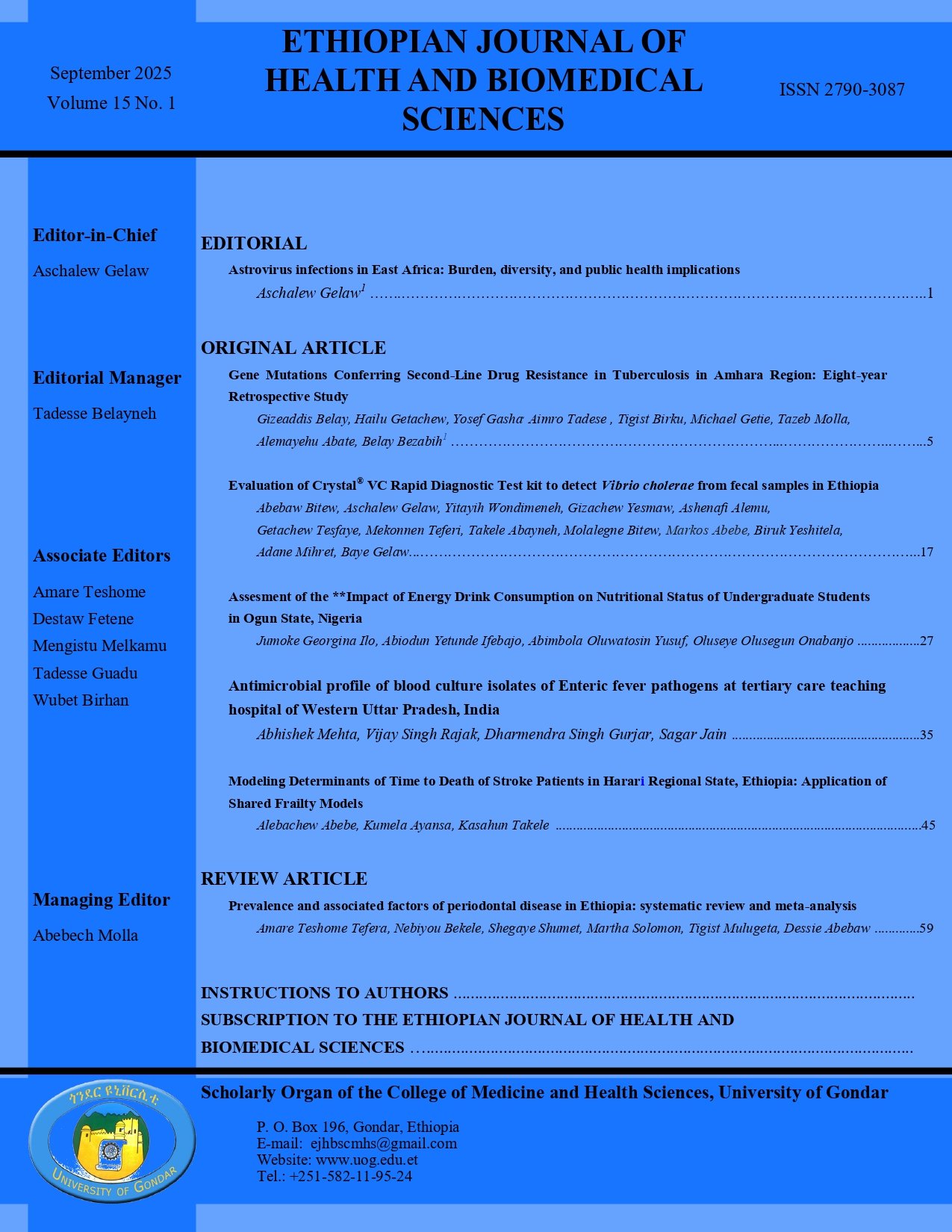
Modeling Determinants of Time to Death of Stroke Patients at Harar Regional State, Ethiopia: Application of Shared Frailty Models
Background: Stroke, a condition caused by interrupted blood flow to the brain, is the second leading cause of death worldwide and a major contributor to morbidity and disability. Despite its global impact, there remains a need for more comprehensive and flexible statistical models to better understand the timing of stroke-related mortality. This study addressed this gap by applying robust shared frailty models to stroke patient data.
Objective: The main purpose of this study was to identify the factors influencing time to death among stroke patients using shared frailty models, accounting for hospital-level clustering effects.
Methods: A retrospective study was conducted at Harar Regional State, Ethiopia, across three hospitals: Harar General Hospital, Jegol hospital, and Hiwot Fana Specialized University Hospital. A total of 224 stroke patients admitted to medical wards between September 1, 2020, and November 1, 2023, were included. Data was coded, cleaned, and entered in to SPSS version 25 and further analyzed using R-Studio. The presence of clustering (frailty) effects among hospitals was evaluated, and different shared frailty models were compared to identify the best-fitting model.
Results: Of the total 224 stroke patients, 51(22.77%) died during the study period, while 173 (77.23%) were censored. The median survival time was estimated at 14 days, highlighting the acute nature of the disease. The Weibull-inverse Gaussian shared frailty model provided the best fit for the data, accounting for unobserved heterogeneity across hospitals. Significant predictors of shorter time to death included hypertension (φ = 2.118; 95% CI: 1.145-3.917), cardiac disease (φ = 2.667; 95% CI: 1.343-5.296), diabetes mellitus (φ = 3.035; 95% CI: 1.1.560-5.906), atrial fibrillation (φ = 3.247; 95% CI: 1.619-6.511), and presence of basic complications (φ = 2.983; 95% CI: 1.477-6.023).
Conclusion: This study highlights the importance of hospital-level clustering effects in survival analysis of stroke patients. The significant frailty effect suggests variability in outcomes across hospitals, underlining the need for tailored interventions. Clinicians and hospital administrators should consider these differences when managing stroke patients, emphasizing timely follow-up, individualized care, and resource allocation to improve survival outcomes.
Keywords
Authors
How to Cite
Download Citation
License
Copyright © 2026 The Author(s)

This work is licensed under a Creative Commons Attribution-NonCommercial 4.0 International License.
Similar Articles
- Amare Minyihun, Masrie Genet, Binyam Tilahun, How to strengthen the Monitoring and Evaluation System to improve Compassionate, Respectful, and Caring services in Ethiopia: An implementation study , Ethiopian Journal of Health and Biomedical Sciences: Vol. 12 No. 1 (2022)
- Andinet Dessalegn, Bernard B Anderson, Cancer of the Anus: A Five Year Review of Cases at Gondar University Hospital and a Thirty-Five Year Experience of a Single Surgeon , Ethiopian Journal of Health and Biomedical Sciences: Vol. 5 No. 1 (2012)
- Aschalew Sime , Walelegn Worku, Occupational Injuries among Workers in Iron and Steel Industries in Bishoftu Town, Oromia Regional State, Ethiopia: a Cross-Sectional Study , Ethiopian Journal of Health and Biomedical Sciences: Vol. 10 No. 1 (2020)
- Mulugeta Aemero, Berhanu Erko, Mogessie Ashenafi, Woldaregay Erku, Assessment on the Status of Salmonella and Schistosoma Coinfections in the Middle Awash Valley and Ziway, Ethiopia” , Ethiopian Journal of Health and Biomedical Sciences: Vol. 6 No. 1 (2014)
- Baye Gelaw, Berhanu Woldu, Habtamu Wondifraw, Melak Aynalem, Yemataw Gelaw, Sileshi Ayele, Prevalence of Anemia and Hemoglobinopathies among Newborns and Delivery Mothers at the University of Gondar Comprehensive Specialized Hospital, Northwest , Ethiopian Journal of Health and Biomedical Sciences: Vol. 16 No. 1 (2026)
- Yemataw Wondie, Yusuf Omer Abdi, Child Sexual Abuse and Its Psychosocial Effects on Female Children in Addis Ababa , Ethiopian Journal of Health and Biomedical Sciences: Vol. 1 No. 1 (2008)
- Zeki Abdurahman, Mohammed Kedir, Chronic Sigmoid Volvulus , Ethiopian Journal of Health and Biomedical Sciences: Vol. 3 No. I (2010)
- Getu Debalkie, Kindie Fentahun, Destaw Fetene , Determinants of Comprehensive Knowledge OF HIV/AIDS among Females Aged 15-24 Years in Ethiopia , Ethiopian Journal of Health and Biomedical Sciences: Vol. 9 No. 1 (2019)
- Betelhem Abera, Zeki Abubeker, Knowledge of Colorectal Cancer Warning Symptoms, Attitudes Toward Early Presentation, and Associated Factors Among Outpatient Attendants at Tikur Anbessa Specialized Hospital, Ethiopia , Ethiopian Journal of Health and Biomedical Sciences: Vol. 16 No. 1 (2026)
- Yitayih Wondimeneh, Moges Tiruneh, Getachew Ferede, Belay Tessema, Diagnostic Performance of SD Bioline Immunochromatography Test for the Detection of Rubella Specific IgM and Igg Antibodies in Resource Limited Settings , Ethiopian Journal of Health and Biomedical Sciences: Vol. 11 No. 1 (2021)
You may also start an advanced similarity search for this article.