
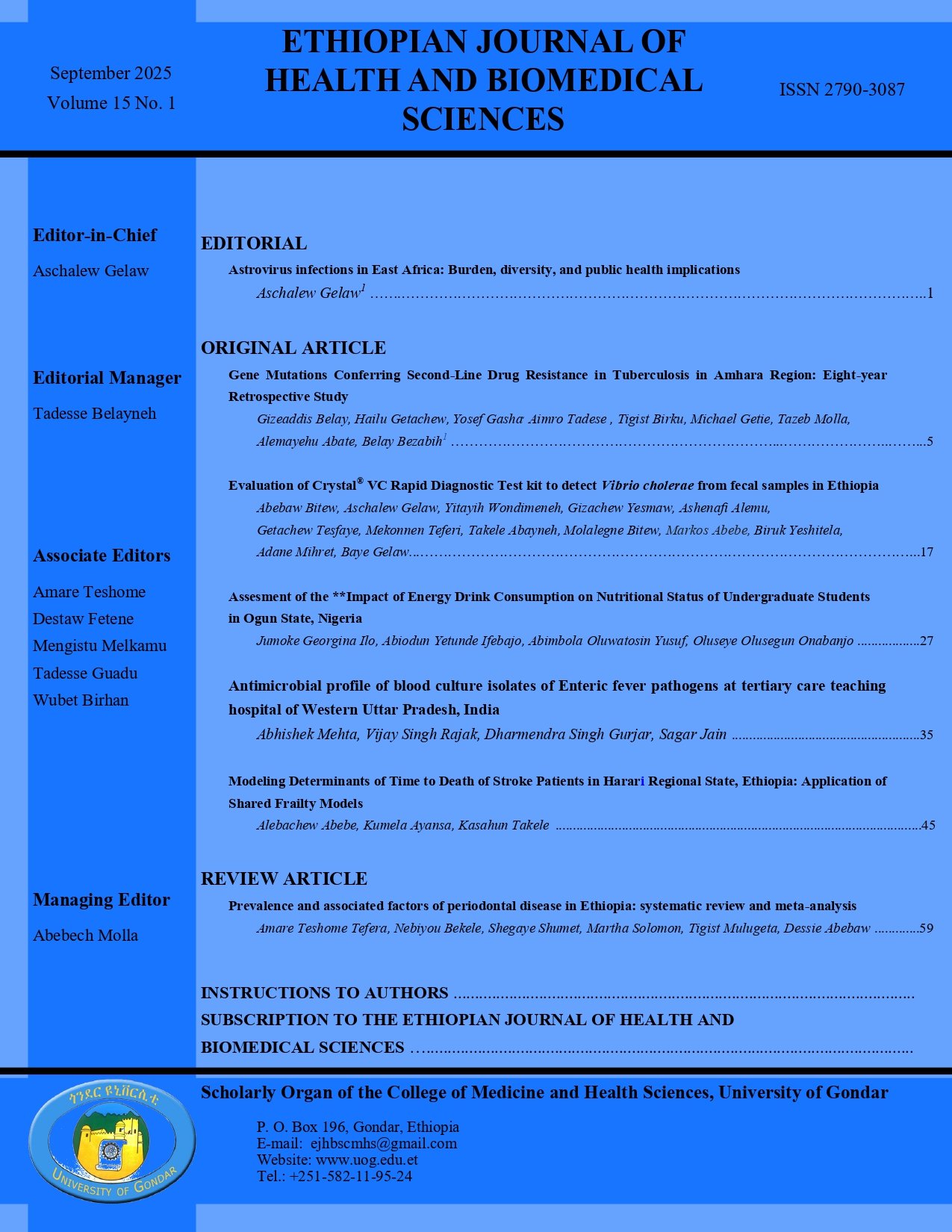
Modeling Determinants of Time to Death of Stroke Patients at Harar Regional State, Ethiopia: Application of Shared Frailty Models
Background: Stroke, a condition caused by interrupted blood flow to the brain, is the second leading cause of death worldwide and a major contributor to morbidity and disability. Despite its global impact, there remains a need for more comprehensive and flexible statistical models to better understand the timing of stroke-related mortality. This study addressed this gap by applying robust shared frailty models to stroke patient data.
Objective: The main purpose of this study was to identify the factors influencing time to death among stroke patients using shared frailty models, accounting for hospital-level clustering effects.
Methods: A retrospective study was conducted at Harar Regional State, Ethiopia, across three hospitals: Harar General Hospital, Jegol hospital, and Hiwot Fana Specialized University Hospital. A total of 224 stroke patients admitted to medical wards between September 1, 2020, and November 1, 2023, were included. Data was coded, cleaned, and entered in to SPSS version 25 and further analyzed using R-Studio. The presence of clustering (frailty) effects among hospitals was evaluated, and different shared frailty models were compared to identify the best-fitting model.
Results: Of the total 224 stroke patients, 51(22.77%) died during the study period, while 173 (77.23%) were censored. The median survival time was estimated at 14 days, highlighting the acute nature of the disease. The Weibull-inverse Gaussian shared frailty model provided the best fit for the data, accounting for unobserved heterogeneity across hospitals. Significant predictors of shorter time to death included hypertension (φ = 2.118; 95% CI: 1.145-3.917), cardiac disease (φ = 2.667; 95% CI: 1.343-5.296), diabetes mellitus (φ = 3.035; 95% CI: 1.1.560-5.906), atrial fibrillation (φ = 3.247; 95% CI: 1.619-6.511), and presence of basic complications (φ = 2.983; 95% CI: 1.477-6.023).
Conclusion: This study highlights the importance of hospital-level clustering effects in survival analysis of stroke patients. The significant frailty effect suggests variability in outcomes across hospitals, underlining the need for tailored interventions. Clinicians and hospital administrators should consider these differences when managing stroke patients, emphasizing timely follow-up, individualized care, and resource allocation to improve survival outcomes.
Keywords
Authors
How to Cite
Download Citation
License
Copyright © 2026 The Author(s)

This work is licensed under a Creative Commons Attribution-NonCommercial 4.0 International License.
Similar Articles
- Desalegn Tegabu, Getahun Asres , Samuel G/Selassie, Patient and Health Service Delay in the Diagnosis and Treatment of Pulmonary Tuberculosis: The Situation at a Teaching and Referral Hospital in Northwest Ethiopia , Ethiopian Journal of Health and Biomedical Sciences: Vol. 5 No. 1 (2012)
- Afework Kassu, Masayuki Fujino, Masako Nishizawa, Getahun Mengistu, Ermias Diro, Belete Ayele, Dereje Ketema, Feleke Moges, Andargachew Mulu, Gizachew Yismaw, Kahsay Huruy, Ebba Abate, Assefa Getachew, Moges Tiruneh, Yared Wondmikun, Wataru Sugiura, Fusao Ota, Levels of serum HIV-1 RNA viral load in tuberculosis patients with or without intestinal parasites during treatment of tuberculosis in Gondar, Ethiopia , Ethiopian Journal of Health and Biomedical Sciences: Vol. 1 No. 1 (2008)
- Mezgebu Yitayal , Yemane Berhane, Alemayehu Worku, Yigzaw Kebede , Graduating Rural Households as Model Families Has Increased Latrine Utilization in West Gojjam Zone, Amhara Region, Ethiopia , Ethiopian Journal of Health and Biomedical Sciences: Vol. 8 No. 1 (2017)
- Mengistu Mekonnen Kelkay, Meseret Kiros Zegeye, Abebaw Addis Gelagay, Bypassing nearby Health Centers for Childbirth Services and its Associated Factors among Mothers Attending Postnatal Care at the University of Gondar Comprehensive Specialized Hospital, 2018: A Facility-based Cross-sectional Study , Ethiopian Journal of Health and Biomedical Sciences: Vol. 13 No. 1 (2023)
- Habtamu Kerebih, Sewbesew Yitayih, Endale Bekele, Behailu Eshetu, Wondale Getnet, Health Related Quality of Life among Patients with Chronic Medical Diseases and Comorbid Depression Related Quality Of Life among Patients with Chronic Medical Diseases and Comorbid Depression , Ethiopian Journal of Health and Biomedical Sciences: Vol. 11 No. 1 (2021)
- Takele Tadesse, Assefa Getachew, Mengesha Admassu, Yigzaw Kebede, Tadesse Awoke, Tesfahun Melese, Solomon Amsalu, Shitaye Alemu, Gashaw Andargie, Belaynew Wassie, Yifokir Tefera, Sisay Yifru, Kassahun Alemu, Samuel G/ Selassie, Solomon Meseret, Demographic and Health Survey at Dabat District in Northwest Ethiopia: Report of the 2008 Baseline Survey , Ethiopian Journal of Health and Biomedical Sciences: Vol. 4 No. 1 (2011)
- Bethelhem Anteneh, Biniam Kefyalew, Tezera Tadele, Binyam Tilahun, Alemayehu Teklu, Zeleke Mekonnen, The role of Community Engagement on Compassionate, Respectful and Caring health service: Perceived effectiveness among health staff in the health system of Ethiopia , Ethiopian Journal of Health and Biomedical Sciences: Vol. 12 No. 1 (2022)
- Gashaw Asnakew, Endale Tefera, Pattern of Childhood Epilepsy and Outcome Determinants at Tikur Anbessa Specialized Hospital, Addis Ababa, Ethiopia , Ethiopian Journal of Health and Biomedical Sciences: Vol. 5 No. 1 (2012)
- Yohanness Sintayehu, Achenef Asmamaw, Tilahun Yemanu, Mehariw Birhan, Relapsing fever outbreak investigation in Beyeda district, North West Ethiopia, 2020,Case control study , Ethiopian Journal of Health and Biomedical Sciences: Vol. 12 No. 2 (2022)
- Mastewal Belayneh Aklil, Wubedle Zelalem Temesgan, Dereje Nibret Gessesse , Bekalu Getnet Kasse , Agumas Eskezia Tiguh, Azmeraw Ambachew Kebede , Minychil Demelash Ayalew , Ayenew Engida Yismaw , Socio-Demographics Correlate of Knowledge, Attitude, and Practice towards COVID -19 Prevention among College Students in Gondar Town, Northwest Ethiopia, 2021: Institutional Based Cross-Sectional Study , Ethiopian Journal of Health and Biomedical Sciences: Vol. 11 No. 1 (2021)
You may also start an advanced similarity search for this article.