
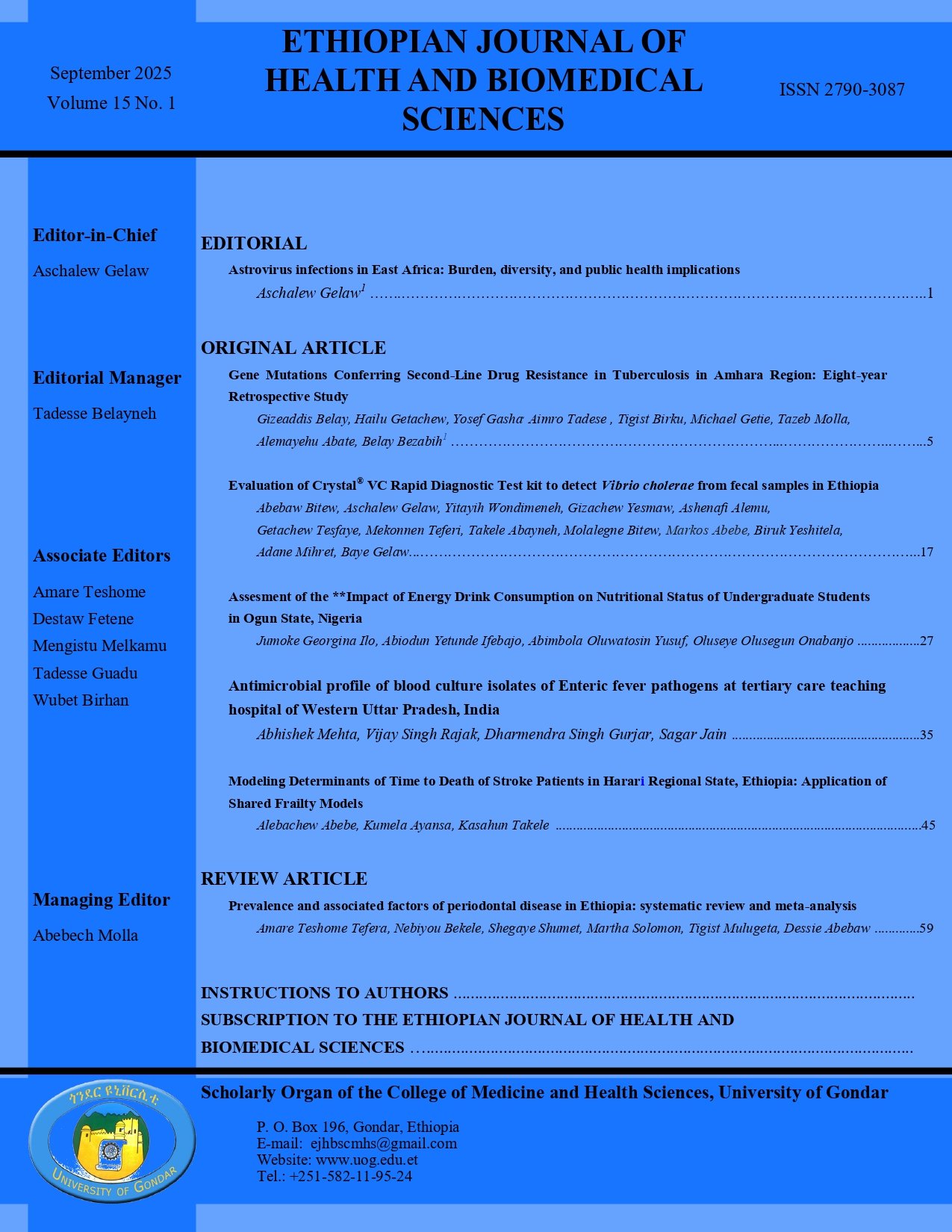
Review on the epidemiology of astrovirus infections in East Africa and its public health significance
Gastroenteritis remains a major global health concern, causing an estimated 2.3 billion illnesses and 1.3 million deaths annually (1). Enteric viruses are responsi-ble for nearly 70% of these cases, with more than 20 distinct viral agents identi-fied to date (2). Among the most common viral causes of diarrhea are members of the Reoviridae, Adenoviridae, Caliciviridae, and Astroviridae families (3). Since their initial discovery in 1975, astrovirus (AstVs) has been recognized as important etiologic agents of viral gastroenteritis , particularly among infants and young children worldwide, with the burden disproportionately higher in low-and middle-income countries (4, 5).
Astroviruses are non-enveloped, icosahedral viruses measuring approximately28–30 nm in diameter, and are distinguished by their characteristic star-like ap-pearance. They belong to the Astroviridae family and have a single-stranded, positive-sense RNA genome of about 6.8 kb in length, which is organized into three open reading frames (ORFs). The ORF1a and ORF1b encode non-structural proteins, while ORF2 encodes capsid proteins (4). The Astroviridae family includes two genera: Mamastrovirus and Avastrovirus. Human infections are primarily associated with Mamastrovirus species, particularly MAstV-1, MAstV-6, MAstV-8, and MAstV-9. The classic HAstVs (HAstV-1 to HAstV-8) belong to MAstV-1, while recently identified novel strains include HAstV-MLB (MAstV-6), HAstV-VA2/4 and HMO-A (MAstV-8), and HAstV-VA1/3, HMO-B/C, and PS (MAstV-9)(6). While several studies from East African countries have reported the presence of HAstVs among under-five children, most have lacked in-depth genetic characterization. Nevertheless, both classic and novel astrovirus types have been detected in the region. Six of the eight classic HAstV types, excluding HAstV-6 and HAstV-7, have been reported in the region. In Ethiopia, HAstV positivity ranged from 3.6% to 5.3%, with genotypes HAstV-1, 2, 3, and 8 detected (7, 8). In Kenya, positivity rates varied between 2.8% and 9.7% across multiple studies, with both classic and non-classic genotypes such as MLB and VA strains identified (9, 10-12). Malawi (1.9%), Sudan (3%), Madagascar (2.1%), and Tanzania (0.4%) also reported HAstV cases (113-16), with Malawi and Madagascar identifying multiple genotypes including HAstV-1 to 5 and HAstV-8 (15, 16). Detection methods varied slightly (RT-PCR, ELISA, EIA).
Astroviruses are primarily associated with gastroenteritis; how-ever, growing evidence also indicates their capacity to cause extra-intestinal infections, including meningitis and encephali-tis (5, 17). These severe manifestations are often linked to nov-el astrovirus strains. In Tanzania, MLB1 and MLB2 strains were detected among febrile children, while the AV1 was iden-tified in a nasopharyngeal sample from another febrile child (18, 19). Although HAstVs predominantly affect children (4), they have also been detected in the elderly, immunocompro-mised individuals, and even healthy adults (20). In immuno-compromised patients, infections tend to be more severe and may involve the central nervous system (20, 5). In tropical climate settings, astrovirus infection often follow seasonal pat-terns, with increased incidence during the rainy season, possi-bly due to increased viral stability in cool, moist environments and greater indoor crowding. Outbreaks have been documented in high-density communal environments such as schools, day-care centers, military facilities, and swimming pools (6). Transmission of HAstVs is mainly fecal-oral, as confirmed by volunteer studies (21), although the role of other transmission routs warrants further investigation.
Despite the recognized global burden of astrovirus-related gas-troenteritis, particularly in young children, research in East Africa remains limited in both population level coverage and depth. Most available studies are confined to under-five chil-dren, with little attention to infections in adults, elderly, or im-munocompromised populations. Comprehensive genomic based evidence is lacking, with limited data on genotype diver-sity, recombination potential, and the emergence of novel strains. Additionally, extra-intestinal manifestations, potential environmental reservoirs, zoonotic transmission, and seasonal patterns are underexplored in the regional context. To address these knowledge gaps, expanded active surveillance and mo-lecular studies are urgently needed. Further research should include diverse age groups, clinical presentation, and compre-hensive one health approach studies to understand of the trans-mission dynamics and detail virological properties. F Further-more, integration of astrovirus monitoring into public health
surveillance programs, alongside investment in vaccine and antiviral development, will be crucial for reducing the disease burden and preventing future outbreaks.
Keywords
Authors
How to Cite
Download Citation
License
Copyright © 2026 The Author(s)

This work is licensed under a Creative Commons Attribution-NonCommercial 4.0 International License.
Similar Articles
- Bisrat Misganaw Geremew, Determinants of exclusive breastfeeding practice among mothers with infants under six months in Ethiopia: A Multilevel Analysis of the 2019 Ethiopian Mini Demographic and Health Survey , Ethiopian Journal of Health and Biomedical Sciences: Vol. 16 No. 1 (2026)
- Belisty Mengist Zelek, Nurilign Abebe Moges, Wasachew Ashebir, Mehari Ambaw, Factors associated with magnitude of exchange of sexually explicit contents among high school students: a cross sectional study , Ethiopian Journal of Health and Biomedical Sciences: Vol. 14 No. 1 (2024)
- Segen Tekle, Feleke Moges, Zemene Tigabu, Alem Getaneh, Bacterial Profile and Their Antibiotic Resistance Patterns from Blood Culture and Associated Risk Factors in Intensive Care Unit at the University Of Gondar Comprehensive Specialized Hospital, Northwest Ethiopia , Ethiopian Journal of Health and Biomedical Sciences: Vol. 10 No. 1 (2020)
- Alemayehu Abate, Michael Getie, Gizeaddis Belay , Desalew Salew, Prevalence and Antimicrobial Resistance Patterns of Gram-Negative Bacteria at Amhara Public Health Institute, Northwest Ethiopia: A Six-Year Retrospective Study , Ethiopian Journal of Health and Biomedical Sciences: Vol. 15 No. 2 (2025)
- Mulugeta Aemero, Berhanu Erko, Mogessie Ashenafi, Woldaregay Erku, Assessment on the Status of Salmonella and Schistosoma Coinfections in the Middle Awash Valley and Ziway, Ethiopia” , Ethiopian Journal of Health and Biomedical Sciences: Vol. 6 No. 1 (2014)
- Lemma Derseh, Belaynew Wasie, Melkie Edris, Unsafe Sexual Practice among Cross-Border Commercial Sex Workers in Mettema Yohannis, Northwest Ethiopia , Ethiopian Journal of Health and Biomedical Sciences: Vol. 5 No. 1 (2012)
- Genet Kiflu, Solomon Amsalu, Melkie Edris, Knowledge, Attitude, and Practice of Fgm, Uvulectomy and Extraction of Canine Milk Teeth Follicle among Mothers of Children under the Age of One Living In Gondar Town , Ethiopian Journal of Health and Biomedical Sciences: Vol. 6 No. 1 (2014)
- Takele Tadesse, Assefa Getachew, Mengesha Admassu, Yigzaw Kebede, Tadesse Awoke, Tesfahun Melese, Solomon Amsalu, Shitaye Alemu, Gashaw Andargie, Belaynew Wassie, Yifokir Tefera, Sisay Yifru, Kassahun Alemu, Samuel G/ Selassie, Solomon Meseret, Demographic and Health Survey at Dabat District in Northwest Ethiopia: Report of the 2008 Baseline Survey , Ethiopian Journal of Health and Biomedical Sciences: Vol. 4 No. 1 (2011)
- Jemal Ali, Huda Mohammed, Adugna Abera, Yohannes Mengistu, Beverley Singh, Adrian Puren, Dawit Wolday, Comparison of the Bed-Igg Captured EIA HIV-1 Incidence Assay with the Who-Criteria for Identifying Recently HIV Infected Individuals for Enrollment in the HIVDR-TS , Ethiopian Journal of Health and Biomedical Sciences: Vol. 5 No. 1 (2012)
- Feleke Moges, Moges Tiruneh, Feleke Moges, Yeshambel Belyhun, Yenew Kebede, Andargachew Mulu, Afework Kassu, Intestinal Parasitic Infections in Association with Cutaneous Fungal Infection and Nutritional Status among Tseda School Children, Northwest Ethiopia , Ethiopian Journal of Health and Biomedical Sciences: Vol. 3 No. I (2010)
You may also start an advanced similarity search for this article.
Most read articles by the same author(s)
- Dessie Tegegne, Aschalew Gelaw, Demeke Endalamaw, Getachew Ferede, Baye Gelaw, The association between ABO blood groups and norovirus infections among patients suffering from diarrheal disease in Northwest Ethiopia , Ethiopian Journal of Health and Biomedical Sciences: Vol. 14 No. 1 (2024)
- Mengistu Endris, Getasew Walle, Belaynew Wassie, Mulugeta Aemiro, Ligabaw Worku, Simon G/tsadik, Takele Teklu, Wubet Birhan, Jemal Ali, Bemnet Amare, Martha Alemayehu, Belay Anagaw, Aschalew Gelaw, Beyene Moges, Yeshambel Belyhun, Wossenseged Lemma, Meseret Delelegn, Prevalence of Intestinal Parasites and Associated Risk Factors among Students of Atse Fasil General Elementary School Azezo, Northwest Ethiopia , Ethiopian Journal of Health and Biomedical Sciences: Vol. 3 No. I (2010)
- Abebaw Bitew, Aschalew Gelaw, Yitayih Wondimeneh, Gizachew Yismaw, Ashenafi Alemu, Getachew esfaye, Mekonnen Teferi, Takele Abayneh, Molalegne Bitew, Markos Abebe, Biruk Yeshitela, Adane Mihret, Baye Gelaw, Evaluation of Crystal® VC Rapid Diagnostic Test kit to detect Vibrio cholerae from fecal samples in Ethiopia , Ethiopian Journal of Health and Biomedical Sciences: Vol. 15 No. 1 (2025)
- Meseret Mulu, Alem Getaneh, Worku Ferede, Aschalew Gelaw, Nasal Carriage Rate Of Methicillin Resistant Staphylococcus Aureus, Antimicrobial Susceptibility Pattern And Associated Risk Factors Among Pregnant Women At The University Of Gondar Comprehensive Specialized Hospital Northwest, Ethiopia , Ethiopian Journal of Health and Biomedical Sciences: Vol. 11 No. 1 (2021)
- Aschalew Gelaw, Detection of Rotarix Vaccine Viruses in Older Children with Acute Gastroenteritis, Northwest Ethiopia , Ethiopian Journal of Health and Biomedical Sciences: Vol. 11 No. 1 (2021)
- Debasu Damtie, Aschalew Gelaw, Recent Updates on SARS-COV-2 Testing, Variants, and Vaccines , Ethiopian Journal of Health and Biomedical Sciences: Vol. 11 No. 1 (2021)
- Aschalew Gelaw, Recent Updates on the Epidemiology and Immunizations of Measles Virus in Ethiopia , Ethiopian Journal of Health and Biomedical Sciences: Vol. 13 No. 2 (2023)
- Awoke Derbie, Daniel Mekonnen, Aschalew Gelaw, From Response to Resilience: Sustaining Vigilance after Ethiopia's first Marburg Virus Disease Outbreak , Ethiopian Journal of Health and Biomedical Sciences: Vol. 15 No. 2 (2025)