
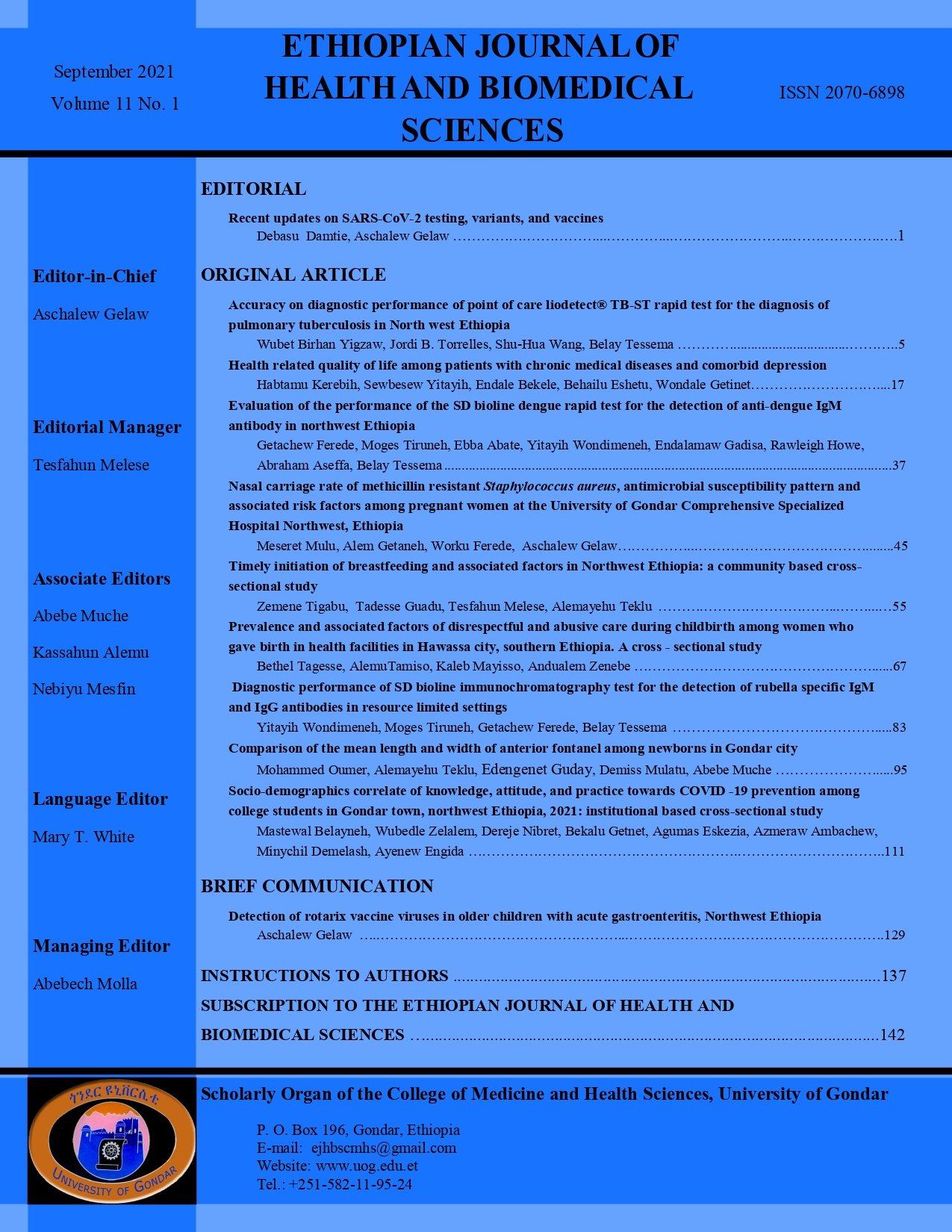
Health Related Quality of Life among Patients with Chronic Medical Diseases and Comorbid Depression Related Quality Of Life among Patients with Chronic Medical Diseases and Comorbid Depression
Background: Health related quality of life has been affected to a greater extent by chronic medical conditions, neurological and psychiatric illnesses. Medical conditions comorbid with psychiatric illnesses have increased negative effect on the health related quality of life of the affected individuals. However, there is a dearth of data in Ethiopia in this aspect. Therefore, the current study assessed the health related quality of life among patients with chronic medical diseases and comorbid depression.
Method: An institutional based cross-sectional study was conducted from May1-June 30/2020 among 377 patients with chronic medical conditions comorbid with depression. Consecutive sampling technique was used to select study participants. World Health Organization Quality of Life (WHOQOL-BREF) questionnaire was used to measure the health related quality of life (HRQOL). Depression was assessed using patient health questionnaire (PHQ-9) whereas perceived stigma was measured using the perceived devaluation and discrimination scale (PDD). The Oslo social support scale (OSSS-3) was used to measure the level of social support. The diagnoses of patients’ chronic medical conditions were extracted from medical charts. Multiple Linear Regression analysis with P-value 0.05 was used to measure the statistically significant association between Quality of life and independent variables.
Result: Out of the 4 domains, the psychological domain of Health related quality of life (HRQOL) had the lowest mean score 39.73±13.44 and the social domain of HRQOL had the highest score 50.13±18.77. Socio-demographic factors including single and divorced marital status, private employed, merchant, farmer and house wife in occupation, unable to read and write, able to read and write and primary school in educational status were significantly associated with one or more of the HRQOL domains. Diagnosis of epilepsy, history of admission, frequency of follow up treatments, history of medication discontinuation, and personal history of mental illness, depression score, perceived stigma score, moderate social support and history of suicidal ideation were the clinical factors significantly associated with various domains of HRQOL.
Conclusion: The mean score of HRQOL domains among chronic medical patients comorbid with depression was low. This could be due to the chronic medical condition and depression had negatively affected quality of life. Every two month treatment follow up frequency, PHQ-9 and stigma score were statistically significant to the four domains of quality of life. Thus, using integrative medical and psychosocial intervention approach emphasizing on factors affecting HRQOL is paramount importance for better outcome.
Keywords
Authors
How to Cite
Download Citation
License
Copyright © 2021 The Author(s)
Similar Articles
- Tadis Brhane, Telake Azale, Knowledge, Attitude, and Practice on Emergency Contraception and Associated Factors among Female Students in Gondar Town, Northwest Ethiopia , Ethiopian Journal of Health and Biomedical Sciences: Vol. 3 No. I (2010)
- Mihretu Jegnie Jegnie, Yared Asmare, Abebe Muche, Anthropometric Measurements of Jugular Foramen in Ethiopian Dried Adult Skulls , Ethiopian Journal of Health and Biomedical Sciences: Vol. 10 No. 1 (2020)
- Baye Gelaw, Mulugeta Aemero, Salie Ayalew, Aschalew Gelaw, Comparison of Sysmex-Kx-21 with Manual Methods: Hemocytometery, Sahli-Hellige and Microhematocrite Methods in Quantitative Hematology Analysis , Ethiopian Journal of Health and Biomedical Sciences: Vol. 2 No. 1 (2009)
- Zemene Tigabu, Tadesse Guadu, Tesfahun Melese, Alemayehu Teklu, Timely Initiation of Breastfeeding and Associated Factors in Northwest Ethiopia: A Community Based Cross-Sectional Study , Ethiopian Journal of Health and Biomedical Sciences: Vol. 11 No. 1 (2021)
- Zegeye Wubeshet Haile, Almaz Gadisa, Eneyew Belay, Obstetric ultrasound screening service utilization among pregnant women in public hospitals in Addis Ababa, Ethiopia: Barriers and Enablers, 2022: a cross-sectional study , Ethiopian Journal of Health and Biomedical Sciences: Vol. 13 No. 2 (2023)
- Mebrate Dufera, Beyene Petros, Tekola Endeshaw, Hussien Mohammed, Afework Kassu, Opportunistic Intestinal Protozoan Parasites among HIV Positive Patients on Antiretroviral Therapy at Nekemte Hospital, West Ethiopia , Ethiopian Journal of Health and Biomedical Sciences: Vol. 1 No. 1 (2008)
- Nahom Worku Teshager, Ashenafi Tazebew Amare, Koku Sissay Tamirat, Kendalem Asmare Atalell, Geta Bayu Genet, The Performance of Modified Pediatric Index of Mortality-2 Scoring System in a Pediatric Intensive Care Unit in Ethiopia , Ethiopian Journal of Health and Biomedical Sciences: Vol. 13 No. 1 (2023)
- Zeki Abdurahman, Mohammed Kedir, Obstructive Jaundice Due To a Fasciola Hepatica Worm in an Ethiopian Patient , Ethiopian Journal of Health and Biomedical Sciences: Vol. 3 No. I (2010)
- Aschalew Gelaw, Recent Updates on the Epidemiology and Immunizations of Measles Virus in Ethiopia , Ethiopian Journal of Health and Biomedical Sciences: Vol. 13 No. 2 (2023)
- Yesuf Adem, Abebe Muche, Prevalence of Intestinal Parasites in Metema District Hospital, Northwest Ethiopia
You may also start an advanced similarity search for this article.